
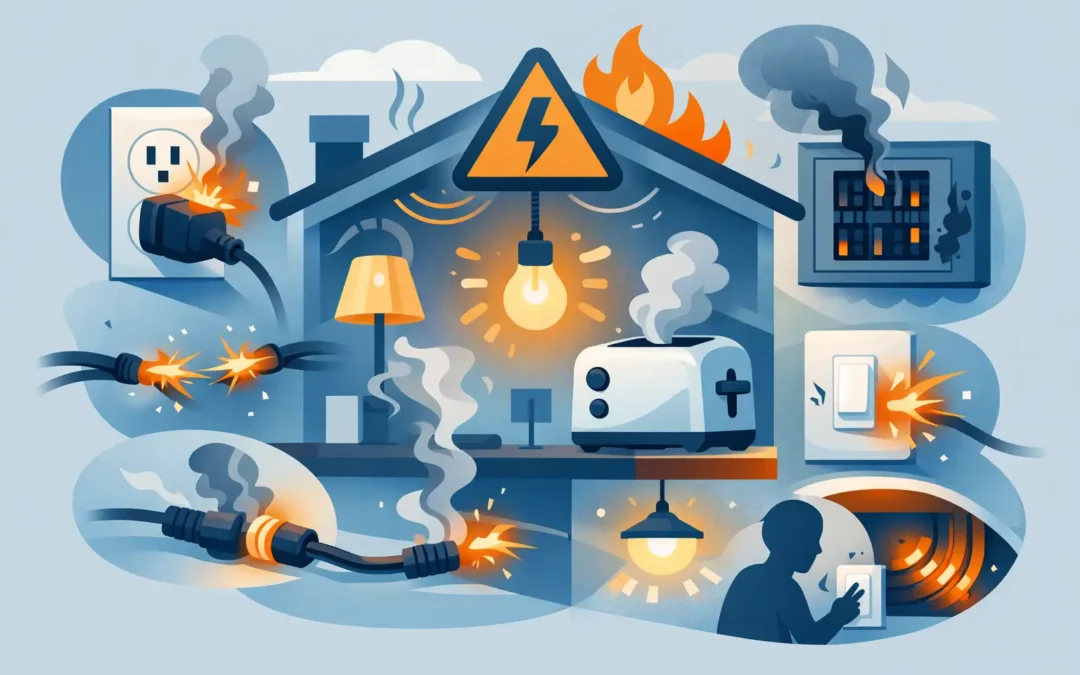
A breaker that trips once after you plug in a space heater is one thing. A breaker that keeps tripping, lights that flicker for no clear reason, or outlets that feel warm to the touch are different. These are some of the top signs of faulty wiring, and they should not be brushed off as small annoyances. Electrical problems tend to get worse, not better, and early warning signs are often the only chance to fix the issue before it turns into a safety hazard.
For homeowners, business owners, and property managers, the challenge is knowing when something is minor and when it points to a deeper wiring problem. Faulty wiring can show up in obvious ways, but it can also hide behind walls, above ceilings, or inside panels while causing intermittent issues that are easy to ignore. If you are seeing repeat electrical problems, the safest move is to have a licensed electrician inspect the system and identify the cause properly.
Top Signs of Faulty Wiring You Should Not Ignore
Some wiring issues are tied to aging electrical systems. Others come from poor installation, overloaded circuits, damaged conductors, loose connections, or renovations that were not done to code. Whatever the cause, the warning signs are usually consistent.
1. Breakers trip repeatedly
Circuit breakers are supposed to shut power off when a circuit is overloaded or unsafe. That protection is a good thing. The problem starts when a breaker trips over and over under normal use.
If the same breaker keeps going, the issue may not be the breaker itself. It could point to loose wiring, a short circuit, damaged insulation, or a circuit carrying more load than it was designed for. In homes and commercial spaces alike, repeated tripping deserves a proper inspection, especially if it happens without adding new equipment.
2. Lights flicker or dim unexpectedly
A flickering light is not always a wiring emergency. Sometimes the bulb is loose or failing. But when multiple lights flicker, dim, or brighten unpredictably, that is often a sign that power is not being delivered consistently.
This can happen because of loose connections, failing wiring, overloaded circuits, or panel issues. If lights change intensity when an appliance starts up, that may also suggest the circuit is struggling to handle demand. In older buildings, this is especially common where wiring was never upgraded to match modern electrical loads.
3. Outlets or switches feel warm
Switch plates and outlets should not feel hot during normal use. A slight warmth from a dimmer switch can be normal in some cases, but noticeable heat from a standard outlet or switch is a red flag.
Heat usually means resistance somewhere in the connection. That could be from loose wiring, deteriorated components, or an overloaded circuit. The longer that condition continues, the more the risk increases. If an outlet is warm, discolored, or gives off a burnt smell, stop using it and have it checked right away.
4. Burning smells or scorch marks
This is one of the clearest signs that something is wrong. If you smell burning plastic, rubber, or a faint smoky odor near outlets, switches, panels, or equipment, do not wait to see if it goes away.
Wiring insulation can melt when conductors overheat. Arcing inside a box or behind a wall can also create that smell before visible damage appears. Scorch marks, darkened outlets, or signs of melting around electrical devices need immediate attention. At that point, the issue has already moved beyond inconvenience.
5. Buzzing sounds from outlets, switches, or panels
Electricity should be quiet. If you hear buzzing, crackling, or humming from an outlet, switch, light fixture, or panel, something is not operating properly.
Sometimes a fixture itself is the problem. Other times, the sound comes from loose connections, failing breakers, poor grounding, or arcing. That distinction matters, because arcing can lead to fire risk if left uncorrected. Any persistent electrical noise should be inspected by a licensed professional rather than guessed at.
Less Obvious Signs of Faulty Wiring
Not every wiring issue announces itself with sparks or smoke. Some signs are less dramatic, but still point to a system that needs attention.
6. Outlets stop working or only work intermittently
An outlet that suddenly stops working may have a tripped GFCI, a failed device, or a breaker issue. But when outlets cut in and out, work only when a plug is positioned a certain way, or lose power without explanation, the wiring connection may be loose or damaged.
Intermittent problems are easy to postpone because the power usually comes back. That is exactly what makes them risky. A loose connection can continue heating and cooling over time until it fails completely or becomes dangerous.
7. Mild shocks or tingling when touching switches or appliances
You should never feel a zap, tingle, or mild shock from a switch, outlet cover, or plugged-in appliance. Even if it seems minor, that sensation can point to grounding problems, damaged wiring, or improper bonding.
This is one of those situations where it depends on the source. A faulty appliance can cause the issue, but so can a wiring defect in the branch circuit. Either way, the safest response is to stop using the affected device or outlet until the cause is identified.
8. Old or damaged wiring materials
If a property still has very old wiring, frayed visible conductors, brittle insulation, or signs of past patchwork repairs, that alone may justify an inspection. Age does not automatically mean failure, but older systems are more likely to have wear, code limitations, and inadequate capacity for current use.
This often comes up during renovations, tenant turnover, panel upgrades, or when adding new equipment. What worked decades ago may not be suitable for today’s appliances, HVAC systems, office equipment, or EV charging needs. A wiring system should be judged by condition and load demand, not just whether it still turns the lights on.
9. Sparking when plugging something in
A very small visible spark can happen occasionally when plugging in certain devices, especially those with a high draw. But frequent sparking, larger sparks, or sparks combined with noise, heat, or discoloration are different.
That may point to a worn outlet, loose internal contacts, or a more serious wiring issue behind the device. If an outlet sparks repeatedly, it should be inspected and likely replaced, with the branch wiring checked at the same time.
10. Rising electrical problems after a renovation or fit-out
Electrical issues that start after a remodel, tenant improvement, equipment installation, or commercial fit-out should never be ignored. New lights, added receptacles, heavier loads, or altered layouts can expose weak points in an existing system or create problems if the work was not done correctly.
This is common in mixed-use buildings, retail spaces, older homes, and offices where the electrical setup has changed over time. Faulty connections, overloaded circuits, and improper extensions of existing wiring can all show up after new work is completed.
When Faulty Wiring Becomes an Emergency
Some problems can wait a day or two for a scheduled service call. Others need immediate action. If you smell burning, see smoke, notice visible sparking, lose power to part of the building unexpectedly, or find a panel, outlet, or switch getting hot, treat it as urgent.
Turn off power to the affected area if it is safe to do so. Do not keep resetting a breaker to force power back on. Do not continue using an outlet that shows signs of heat or damage. Electrical faults are not the kind of issue to monitor casually, because the risk is not just inconvenience – it is fire, equipment damage, and personal injury.
What a Licensed Electrician Will Check
When diagnosing faulty wiring, the goal is not just to replace the device that is acting up. A proper inspection should trace the problem back to its source. That may include testing circuits, checking outlet and switch connections, inspecting the panel, verifying grounding and bonding, and reviewing whether the circuit is correctly sized for the load.
In some cases, the fix is straightforward, such as replacing a damaged outlet or tightening a loose connection. In others, the problem points to a larger issue like deteriorated branch wiring, an undersized panel, or unpermitted past work that needs correction. That is why accurate diagnosis matters. Guesswork can leave the real hazard in place.
For property owners in Toronto and the GTA, fast electrical service matters when safety or business continuity is on the line. Eclipse Electrical Services handles these situations with practical troubleshooting and licensed repair work, whether the issue is inside a home, office, retail unit, or industrial space.
Don’t Wait for a Small Sign to Become a Bigger Problem
Electrical systems usually give warning signs before a major failure, but they do not give unlimited chances. If you have noticed any of these top signs of faulty wiring, it is worth getting the issue checked before it turns into downtime, damaged equipment, or a serious safety problem. A prompt inspection now is often simpler and less expensive than dealing with the consequences later.