
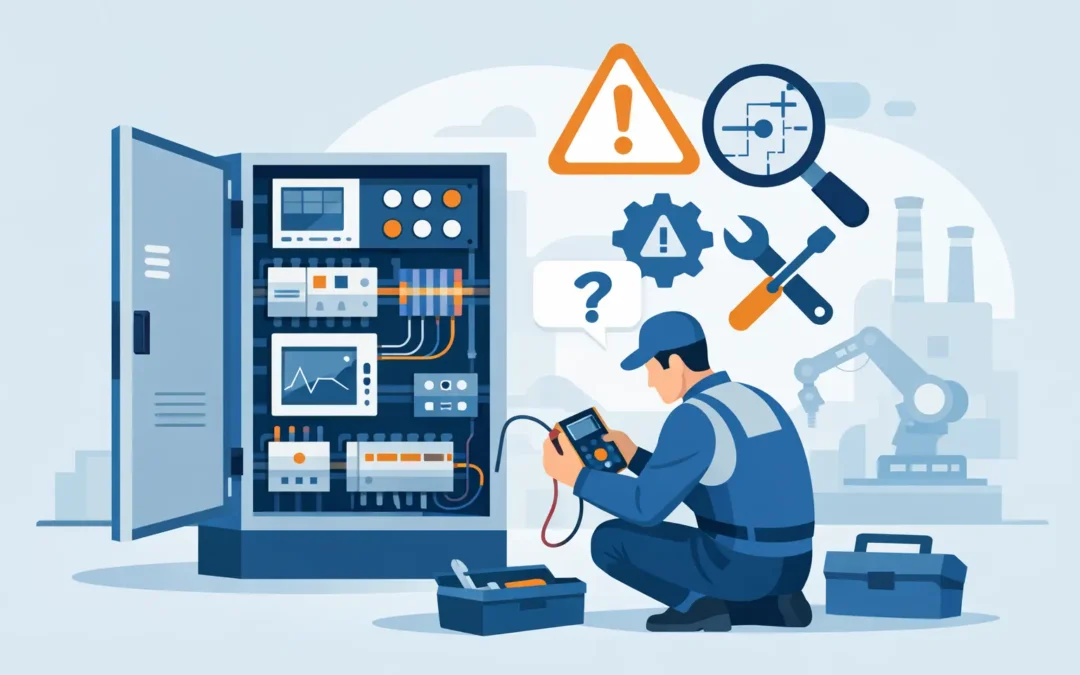
A conveyor stops mid-run, a motor overload trips repeatedly, or an HMI screen goes dark just as production is getting underway. Industrial control panel troubleshooting is not simply a matter of replacing the first component that looks suspicious. A panel fault can come from incoming power, a loose termination, a failed control device, a field wiring issue, a programming problem, or the equipment being controlled.
The fastest way back to safe operation is a disciplined diagnostic process. It protects personnel, prevents unnecessary parts replacement, and helps identify whether the problem is a simple repair or a sign that the panel needs a more substantial upgrade.
Start With Safety and a Clear Fault Description
Industrial control panels can contain high fault current, exposed energized conductors, stored energy, and equipment that can restart automatically. Troubleshooting should be performed by qualified electrical personnel who understand the equipment, the available incident energy, and the site’s lockout/tagout requirements.
Before opening the enclosure, collect the details that often point to the real cause. Ask what stopped working, what happened immediately before the fault, whether the issue is constant or intermittent, and whether any alarms or indicator lights appeared. A fault that occurs only when a motor starts is different from one that appears after several hours of operation.
Review the panel drawings, previous service reports, and machine documentation when available. Good documentation saves time, but an older panel may not match its original drawings after years of modifications. Treat labels and prints as useful references, then verify the actual circuit before making decisions.
Industrial Control Panel Troubleshooting: Check Power First
Many faults that appear to be control problems are power quality or supply problems. Start at the source and work toward the load. Verify that the correct voltage is present at the incoming disconnect, main breaker, transformer, and power supply. Check all phases where applicable, along with phase-to-phase and phase-to-ground readings.
A missing phase can leave some control devices energized while preventing a three-phase motor from operating correctly. Low voltage may cause contactors to chatter, relays to drop out, PLCs to reset, or variable frequency drives to fault. Voltage that appears normal with no load can still collapse when equipment starts, so measurements may need to be taken under operating conditions by a qualified technician using the proper test equipment.
Do not overlook simple mechanical issues at the power entry. A loose lug, corroded terminal, damaged disconnect, overheated breaker connection, or undersized conductor can create heat and intermittent operation. Discoloration, melted insulation, a burnt odor, or repeated heat-related failures should be treated as warning signs, not cosmetic defects.
Inspect the Control Power Circuit
Once incoming power is confirmed, check the lower-voltage control circuit. This may include a control transformer, 24-volt DC power supply, fuses, miniature breakers, safety relays, PLC inputs and outputs, and interface relays.
A blown fuse is a symptom, not a diagnosis. Replacing it without finding the short circuit, failed coil, damaged cable, or overloaded device behind it may put the panel right back into fault. Check the fuse rating against the drawings and inspect downstream components before restoring power.
Power supplies also deserve close attention. A 24-volt DC supply that is overloaded or failing can produce unstable voltage and unpredictable control behavior. If several sensors, relays, or PLC modules are acting erratically at once, the control power supply and its wiring should be high on the inspection list.
Follow the Circuit, Not Assumptions
Effective troubleshooting follows the path the signal must take for the machine to run. For a motor starter, that path may run from a stop button and emergency stop circuit through overload contacts, safety devices, selector switches, relay contacts, a PLC output, and finally the contactor coil. Any open point in that chain can stop the starter from energizing.
Use the schematic to identify what should be energized and what conditions must be met. Then test methodically, one point at a time. Avoid jumping terminals or bypassing safeties to “see if it runs.” Bypassing an interlock can damage equipment, create an unsafe condition, and hide the original fault.
Intermittent problems require extra patience. Vibration, heat, moisture, and normal panel movement can expose loose connections that look fine during a quick visual check. With the equipment safely isolated, inspect terminals, wire ferrules, relay bases, contactor connections, cable glands, and grounding conductors. A properly performed torque check may reveal a connection that has loosened over time.
Common Faults Inside Industrial Control Panels
The same failures appear regularly in manufacturing facilities, warehouses, pumping systems, and commercial mechanical equipment. The cause varies, but recognizing the patterns can shorten downtime.
A contactor that hums or chatters may have low coil voltage, a worn coil, debris in the contact assembly, or a weak control transformer. A motor overload that trips repeatedly may indicate excessive mechanical load, a failed bearing, incorrect overload settings, poor ventilation, a missing phase, or a motor that is beginning to fail.
If a breaker trips immediately, look for a short circuit, damaged wiring, a failed component, or an incorrect breaker selection. If it trips only after operation, investigate overload conditions, heat buildup, loose connections, and equipment duty cycle. Resetting a breaker repeatedly without testing the circuit can turn a repairable fault into damaged equipment.
PLC-related faults also need a practical approach. Confirm that the processor has power, the correct status lights are present, and the affected input or output is changing state as expected. An inactive PLC output does not always mean the PLC has failed. The program may be holding that output off because a limit switch, safety relay, sensor, overload, or process condition is not satisfied.
For drives and soft starters, record the exact fault code before resetting the device. The code can indicate overcurrent, ground fault, phase loss, overheating, communication loss, or an external interlock condition. Clearing the code without documenting it removes valuable evidence and often leads to repeat service calls.
Look Beyond the Panel
A control panel is only one part of the system. Field devices frequently create the fault. A damaged sensor cable, misaligned photo eye, stuck float switch, failed solenoid coil, blocked pump, jammed conveyor, or defective motor can all make a healthy panel appear faulty.
Check whether the panel receives the expected field signal and whether the output reaches the device. If voltage is present at a motor starter output but the motor does not run, the issue may be in the motor, disconnect, cable, or mechanical load. If the panel never receives a sensor input, inspect the sensor, its alignment, its supply voltage, and the field wiring before replacing control components.
Environmental conditions matter too. Dust, oil mist, condensation, insects, excessive heat, and vibration shorten the life of electrical components. Panels installed near washdown areas or unconditioned spaces may need improved enclosure ratings, sealing, cooling, or relocation to prevent recurring failures.
When Repair Is Not Enough
A single failed relay or damaged wire can often be repaired quickly. But recurring failures may point to a panel that no longer suits the equipment or operating environment. Older panels may have obsolete components, limited spare capacity, poor labeling, insufficient short-circuit protection, inadequate ventilation, or modifications that no longer meet current operational needs.
An upgrade can be the better investment when downtime is expensive or replacement parts are difficult to source. Common improvements include new disconnects and breakers, properly sized power supplies, updated motor starters, VFD installations, surge protection, improved labeling, terminal blocks, panel cooling, and documented wiring changes. The right scope depends on the equipment, available fault current, process requirements, and the condition of the existing installation.
For industrial facilities in Toronto and the GTA, Eclipse Electrical Services can help assess control panel faults, repair damaged components, and identify practical upgrades before a small electrical issue becomes a longer shutdown. A clear diagnosis and properly documented repair give your team a safer panel and a better starting point the next time service is needed.