
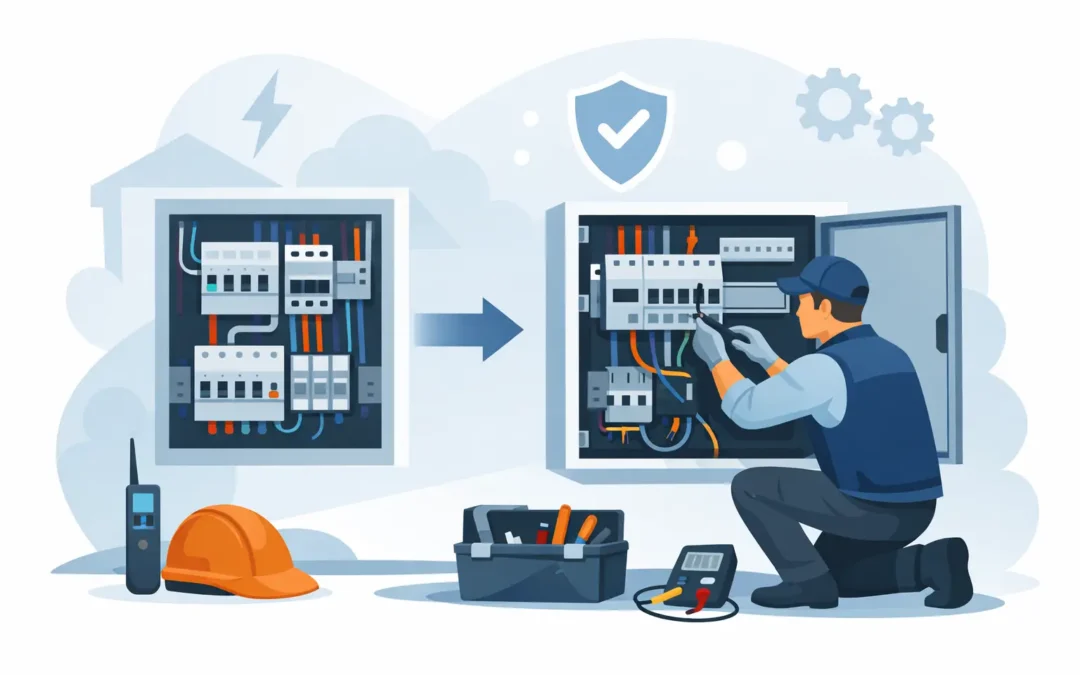
If your breakers trip when the AC starts, the lights dip when equipment kicks on, or your panel still relies on fuses, you are probably asking how to upgrade switchboard equipment without turning it into a bigger problem. That is the right question to ask early, because switchboard issues rarely stay small for long.
A switchboard upgrade is not just about adding capacity. In many homes, shops, offices, and light industrial spaces, it is about safety, code compliance, and making sure the electrical system can handle how the building is actually used now. Older boards were often sized for a very different load than what people expect today.
When a switchboard upgrade makes sense
Some upgrades are planned as part of a renovation or fit-out. Others happen because the existing board has become unreliable. If you are adding HVAC equipment, EV charging, new machinery, larger kitchen loads, or more tenant improvements, the existing switchboard may simply be undersized.
There are also warning signs that should not be ignored. Frequent breaker trips, overheating, buzzing, scorch marks, corrosion, loose connections, and obsolete equipment all point to a system that needs professional attention. In commercial settings, lack of spare breaker space is another common trigger. If every new circuit requires a workaround, the board is already telling you it has reached its limit.
For some buildings, the issue is not just capacity. It is age. Older switchboards may not meet current safety standards, may not support modern protective devices, and may have parts that are difficult or impossible to source. That creates downtime risk as much as electrical risk.
How to upgrade switchboard systems properly
The short answer is that a licensed electrician starts with load assessment, equipment inspection, and service review before any replacement is planned. The exact path depends on the building, the utility service, and what the upgraded board needs to support.
Step 1: Assess the existing electrical load
This is where a lot of bad decisions are avoided. A proper assessment looks at connected loads, demand patterns, future expansion, and whether the problem is the switchboard itself or the incoming service size. In a house, that may mean reviewing major appliances, HVAC, a hot tub, or EV charger plans. In a commercial unit, it may mean lighting, HVAC, refrigeration, office equipment, tenant loads, or specialized machinery.
If the board is crowded but the actual demand is modest, there may be a more targeted solution. If the service is already strained, replacing the board alone may not solve the problem.
Step 2: Inspect the condition of the current board
Not every older board needs full replacement, but many do. An electrician will look for heat damage, corrosion, improper wiring, double-tapped breakers, outdated fuse protection, and signs of arcing. They will also check whether the manufacturer and model have a known history of failure or limited parts availability.
This step matters because sometimes the board can be reconfigured or partially upgraded, and sometimes that would be a waste of money. If the enclosure, bus bars, or main disconnect are compromised, replacement is the safer call.
Step 3: Confirm service capacity and utility requirements
A bigger switchboard does not automatically mean a bigger electrical service. If the property needs more amperage, the service conductors, meter base, grounding, and utility coordination may all need to be addressed. That can change the scope, cost, and timeline of the work.
This is one of the biggest trade-offs in any project. A straightforward panel or switchboard replacement can often be completed faster than a full service upgrade. But if the building is growing, stopping short of the service upgrade may only delay the next problem.
Step 4: Size the new switchboard for current and future use
The goal is not to install the biggest board possible. It is to install one that is correctly sized, code-compliant, and practical for the property. That usually means enough capacity for present loads plus reasonable room for expansion.
For homeowners, that might mean planning ahead for an EV charger, finished basement, heat pump, or workshop. For business owners and facility managers, it often means allowing for future circuits, equipment changes, or tenant needs. A board with no room to grow can become a limitation surprisingly fast.
Step 5: Handle permits, code, and shutdown planning
A switchboard upgrade is licensed electrical work. In many cases, it also requires permits, utility coordination, and inspections. For occupied properties, shutdown planning is part of the job. Businesses may need after-hours scheduling or phased work to limit disruption.
This is where experience matters. Good planning keeps downtime controlled and reduces the risk of surprises once the power is off.
Step 6: Remove the old equipment and install the new board
Once approvals and scheduling are in place, the old board is disconnected and removed, and the new switchboard is installed with properly labeled circuits, updated grounding and bonding, and the correct protective devices. Depending on the site, this may also include new feeders, conduit adjustments, meter upgrades, surge protection, or subpanel work.
Clean workmanship is not a cosmetic issue. A neat, clearly organized board is safer to service, easier to troubleshoot, and less likely to hide wiring problems later.
Step 7: Test, inspect, and document the work
After installation, the system should be tested, inspected as required, and clearly documented. Breakers should be labeled accurately, loads verified, and any operational notes shared with the owner or site manager.
For commercial and industrial clients, documentation is especially useful for maintenance teams and future fit-outs. It saves time and reduces guesswork.
What affects the cost
The biggest cost factors are board size, service size, building type, ease of access, permit requirements, and whether the job includes a full service upgrade. Replacing a tired board with a similar size unit is very different from increasing capacity, relocating equipment, or upgrading service conductors.
Commercial and industrial switchboards can also involve higher costs because of shutdown coordination, specialized gear, and custom distribution needs. If the work has to happen outside normal business hours to avoid downtime, that can affect pricing too.
Trying to cut corners on switchboard work usually costs more later. Poor load planning, reused damaged components, or rushed installation can lead to nuisance tripping, failed inspections, and repeat service calls.
Common mistakes property owners make
One mistake is assuming a tripping breaker always means the breaker is bad. Sometimes it is doing exactly what it should because the circuit is overloaded or there is a fault elsewhere. Replacing parts without diagnosing the root issue can mask a serious problem.
Another mistake is thinking a panel swap and a switchboard upgrade are always the same thing. In smaller residential settings, people often use the terms loosely. In commercial and larger multi-circuit environments, the scope can be much more complex, with feeder coordination, disconnecting means, and service distribution all in play.
The third mistake is waiting too long. Heat, looseness, and aging equipment do not improve with time. If there are signs of damage, delay increases both safety risk and the chance of an unplanned outage.
Residential, commercial, and industrial upgrades are not identical
The basic principles are similar, but the execution changes by property type. Residential work is usually more straightforward, though older homes can bring hidden wiring issues. Commercial projects often require tighter scheduling, more circuit coordination, and careful planning around tenant operations. Industrial sites may involve heavier loads, specialized gear, and a stronger focus on operational continuity and fault protection.
That is why there is no single answer to how to upgrade switchboard equipment. The right solution depends on the building, the demand, and how much future growth needs to be built into the system.
Choosing the right electrician for the job
This is not a handyman project and it is not a place to shop on price alone. You want a licensed electrical contractor who can assess load properly, explain your options in plain language, handle permits and inspections, and complete the work with minimal disruption.
If you manage a business or facility, ask how downtime will be handled. If you own a home, ask whether the upgrade leaves room for future additions. If you are dealing with older or damaged equipment, ask whether replacement parts are still reliable and available. Straight answers matter.
At Eclipse Electrical Services, this is the kind of work we approach practically – assess the risk, size the system correctly, do the work cleanly, and keep the process clear from start to finish.
If your switchboard is showing its age or your building has outgrown it, the best next step is not guesswork. Get it inspected, get a clear scope, and make the upgrade before a small warning sign turns into a shutdown.