
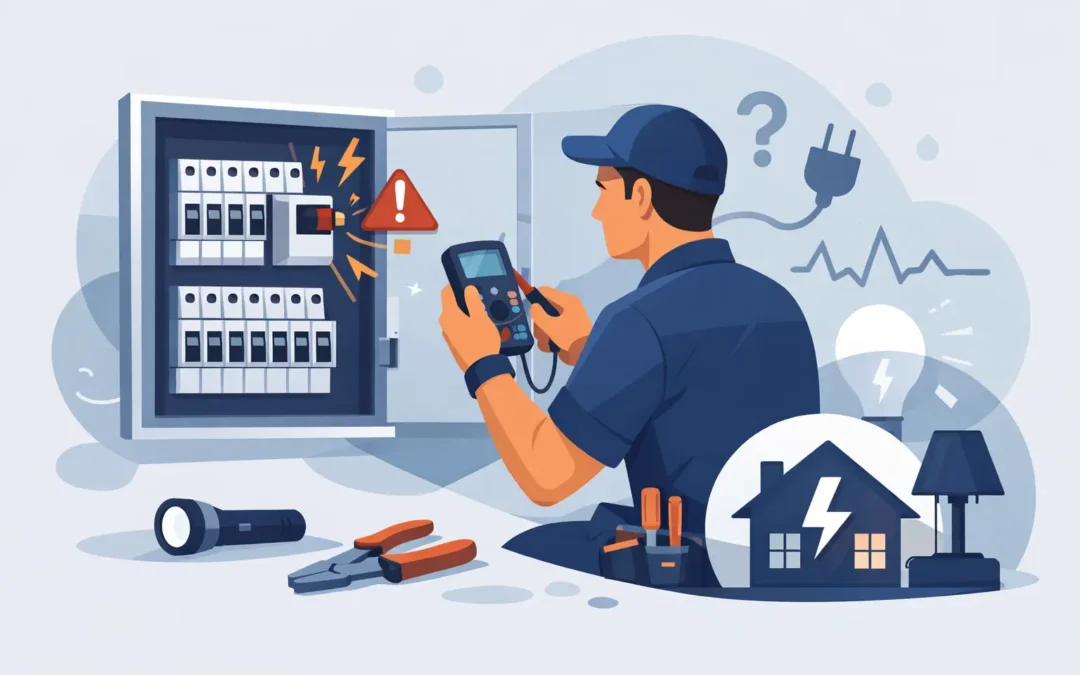
A breaker that trips once during a storm might be a fluke. A breaker that keeps tripping is your electrical system telling you something is wrong. If you are looking for how to troubleshoot tripping breakers, the first step is not forcing the switch back on again and again. The safer approach is to narrow down the cause, protect the circuit, and call a licensed electrician when the signs point to a real fault.
In homes, offices, retail units, and light industrial spaces, breaker trips usually come down to a short list of issues. The circuit may be overloaded, there may be a short circuit or ground fault, the breaker itself may be failing, or the equipment on that circuit may have a problem. Older panels and renovated properties can add another layer, especially when circuits have been extended over time without enough capacity.
How to troubleshoot tripping breakers safely
Start with the basics. Go to the electrical panel and identify which breaker has tripped. It will usually sit in the middle position, between on and off. Before resetting it, unplug or turn off everything on that circuit if you can. Then switch the breaker fully to off and back to on.
What happens next matters. If the breaker holds and stays on, the problem may be tied to something that was running on the circuit. If it trips immediately, that points more toward a wiring fault, a bad device, or a failed breaker. If it trips after a few minutes, overload or heat buildup becomes more likely.
Do not keep resetting a breaker that trips instantly. That is one of the clearest signs the issue is not random. A breaker is a safety device, and repeated resets can make a bad situation worse.
Start by ruling out an overloaded circuit
Overload is the most common cause, especially in kitchens, bathrooms, garages, workshops, and commercial spaces where several devices may run at once. Space heaters, microwaves, kettles, hair dryers, portable AC units, compressors, and power tools can push a circuit past its limit quickly.
A simple test is to leave the breaker on with everything unplugged or switched off. Then reconnect items one at a time. If the breaker trips only when a certain combination is running, the circuit is likely overloaded.
This is where real-world use matters more than theory. A circuit might be technically fine most of the day and still trip every morning when coffee equipment, toasters, and lights all come on together. In a business, the same thing happens when printers, POS systems, display lighting, and break room appliances share more load than the circuit was meant to carry.
If overload is the issue, the fix is not a bigger breaker. The fix might be redistributing devices, adding dedicated circuits, or upgrading parts of the electrical system so the load is handled properly.
Check whether one device is causing the trip
If the breaker stays on until you plug in a specific appliance or piece of equipment, that item may be the problem. Faulty heaters, refrigerators, sump pumps, treadmills, microwaves, and older commercial equipment are common examples.
Watch for signs such as a burnt smell, buzzing, heat at the plug, intermittent operation, or a cord that feels damaged. If one device repeatedly trips the breaker, stop using it until it is inspected or replaced.
This can save time because it separates a circuit problem from an equipment problem. If the breaker holds with everything else connected except one item, the circuit may be doing its job correctly by shutting off power before damage occurs.
Look for clues of a short circuit or ground fault
When a breaker trips the moment a switch is flipped or a device is plugged in, a short circuit or ground fault becomes more likely. These faults happen when electricity takes an unintended path, often because of damaged insulation, loose connections, moisture, or worn-out equipment.
Some clues are easy to spot. You may notice scorch marks near an outlet, a burning odor, crackling sounds, a tripping breaker tied to one light switch, or problems that started after water exposure. In basements, kitchens, exterior outlets, bathrooms, and utility rooms, moisture is often part of the story.
This is not the point to remove devices from the wall or open the panel yourself unless you are qualified to do that work. Fault finding inside the system needs testing, not guesswork. A licensed electrician can isolate the affected section safely and confirm whether the issue is in the cable, receptacle, switch, fixture, or connected equipment.
Don’t ignore arc fault and GFCI patterns
Some newer circuits are protected by AFCI or GFCI devices, either at the breaker or outlet. These trip for different reasons than a standard overload breaker. An AFCI reacts to dangerous arcing that can happen with damaged wires or loose terminations. A GFCI reacts when electricity leaks from the intended path, often around water or damp conditions.
If a bathroom receptacle, kitchen outlet, garage plug, or exterior circuit trips without heavy load, that does not mean the protection is faulty. It may mean the device is sensing a real hazard. The challenge is that nuisance trips can happen too, especially with older appliances or mixed wiring conditions. That is why the pattern matters. If trips happen only during rain, only when a certain tool is used, or only on one outlet, those details help narrow the diagnosis.
The breaker itself can fail
Breakers do wear out. It is not the first thing to assume, but it does happen, especially in older panels or circuits that trip often. A weak breaker may trip below its rated load, feel loose when reset, or fail to stay engaged even when the circuit is disconnected from normal use.
The trade-off here is that replacing a breaker without proper testing can miss the real problem. Sometimes the breaker is bad. Sometimes it is reacting correctly to a hidden fault behind the walls. A proper inspection checks both.
In commercial or industrial settings, breaker problems can also involve panel heat, loose bus connections, or equipment startup loads that need a different circuit design. Those situations need more than a quick reset and should be treated as service calls.
When tripping breakers point to a larger electrical issue
If multiple breakers are tripping, lights are flickering across different rooms, or you have recurring issues after a renovation or equipment upgrade, the problem may be bigger than one branch circuit. Service capacity, panel condition, subpanel wiring, or load balancing may need review.
This comes up often in older properties that now support more electronics, more appliances, EV chargers, or added HVAC equipment than they were originally designed for. It also happens in retail and office spaces where layouts changed but the electrical distribution never fully caught up.
When that is the case, troubleshooting is less about one bad breaker and more about whether the system still fits the building’s actual use.
When to stop troubleshooting and call an electrician
There is a clear point where safe observation should end and electrical testing should begin. Call a licensed electrician if the breaker trips immediately after reset, trips with nothing plugged in, shows signs of heat or burning, affects critical equipment, or keeps returning as the same problem.
You should also call if the panel is older, unlabeled, buzzing, or showing corrosion, or if the issue started after water exposure, construction, or a new appliance installation. In a business, downtime matters. In a home, safety matters just as much. Either way, waiting usually does not make the repair simpler.
At Eclipse Electrical Services, this is exactly the kind of fault we handle for homeowners, property managers, and commercial clients who need a fast, practical answer instead of trial and error.
What to do while you wait for service
Leave the problem breaker off if it will not hold safely. Unplug the suspected device if one item appears to be causing the trip. If food storage, medical equipment, or business operations are affected, move those loads to a known safe circuit only if you can do so without overloading it.
Avoid extension-cord workarounds as a long-term fix. They often shift the risk instead of solving it. If there is any smell of burning, visible damage, or heat at the panel or receptacles, treat it as urgent.
A tripping breaker is not just an inconvenience. It is one of the few parts of your electrical system that tells you, clearly and immediately, when something needs attention. The best next step is not guessing harder. It is narrowing the cause safely, then getting the right repair done before a small fault becomes a bigger one.