
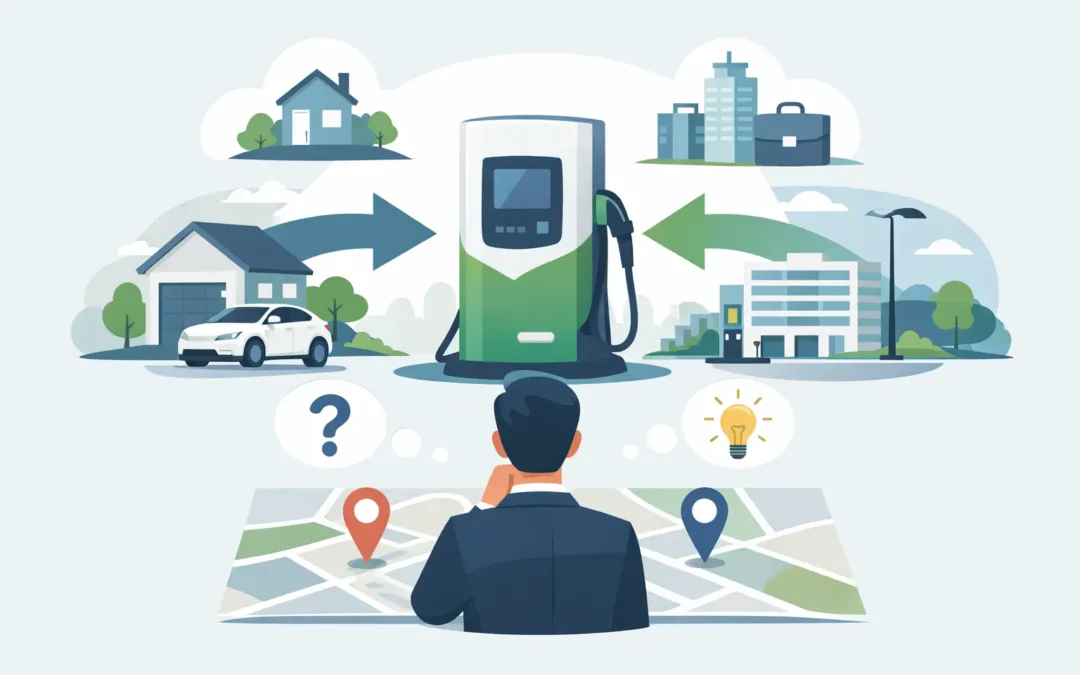
The wrong charger location becomes a daily annoyance fast. A cable that barely reaches, a parking layout that forces awkward maneuvering, or a panel too far from the install point can all turn a simple EV charger project into a more expensive one. If you are figuring out how to choose EV charger location, the best place is usually the one that balances convenience, electrical access, safety, and room for future use.
For most properties, that means looking at more than just where the car parks today. You also need to think about cable length, panel capacity, wall space, weather exposure, and whether that spot still makes sense if you add another EV later. A good location saves time every day and helps avoid unnecessary installation costs.
How to Choose EV Charger Location at Home
At a house, convenience usually comes first, but it should not be the only factor. The charger should be close enough to your usual parking spot that plugging in feels easy, not like a chore. If you need to back in at a strange angle or stretch the cable across the garage every night, the setup will wear on you.
The best starting point is your normal parking habit. If one vehicle always parks on the left side of the garage, install with that in mind. If you park outside on the driveway, think about the exact space the vehicle uses most often, not an idealized version of it. A charger placed for occasional use instead of daily use often ends up in the wrong spot.
The next issue is cable reach. Charger cables are not meant to solve a bad layout. A longer cable can help, but it should not need to cross a walkway, drape over stored items, or sit where it can be driven over. You want a location where the connector can reach the charge port cleanly and without strain.
Garage wall space matters too. The charger needs a solid mounting area with enough clearance for safe use and service access. If that wall is already crowded with shelving, bikes, tools, or a garage door track, another spot may be better even if it looks closer on paper.
Distance From the Electrical Panel Changes Cost
One of the biggest factors in charger placement is the run from the electrical panel to the charger. In simple terms, shorter runs usually mean lower installation cost. Less conduit, less wire, and less labor often make a nearby location more practical.
That said, nearest is not always best. A charger beside the panel can still be a poor choice if it makes parking difficult or puts the equipment in a vulnerable spot. This is where a licensed electrician helps. The right answer is often a balance between daily convenience and installation efficiency.
If your panel is in the basement and the charger is planned for a detached garage or the far side of the building, the job can become more involved. Trenching, surface-mounted conduit, wall penetrations, or panel upgrades may all come into play. None of that means the location is wrong. It just means the true cost should be understood before you commit.
Safety Comes Before Convenience
A charger should be easy to reach, but it should also be protected from impact, water issues, and physical damage. Mounting a unit where it can be clipped by a car door or bumped by a vehicle is asking for trouble.
At home, avoid placing the charger where the cable has to cross a main walking path. In a garage, that can create a trip hazard. Outside, it can interfere with sidewalks, snow clearing, or general movement around the property. The safest setup is one where the charger and cable stay close to the vehicle and out of the way.
You also want a location that supports proper mounting height and code-compliant installation. Outdoor chargers need suitable weather protection and equipment rated for the conditions. In places with heavy snow, ice, and freeze-thaw cycles, placement matters even more. A low-mounted charger near pooled water or packed snow is not a smart long-term choice.
Indoor vs Outdoor EV Charger Placement
If you have both options, indoor installation is often simpler. A garage provides better weather protection, cleaner cable storage, and less exposure to temperature swings. It can also help extend the life of the equipment.
But indoor is not automatically better. Some garages are too tight, poorly laid out, or not used for parking at all. In those cases, an outdoor charger near the driveway may be more practical and more likely to get used properly.
For outdoor installs, think about rain exposure, direct sun, snow buildup, and vehicle traffic. A side wall near the parking area often works better than the front of the house, where the unit may be more exposed or visually intrusive. The charger should be accessible without becoming an obstacle.
There is also a security angle. At some properties, a charger mounted in a more visible area discourages tampering. At others, a more sheltered side location makes more sense. It depends on the layout, lighting, and how the property is used.
Commercial and Multi-Vehicle Properties Need a Different Approach
For businesses, how to choose EV charger location is less about one driver and more about traffic flow, visibility, and operational use. A charger that works fine for a single home can be completely wrong for a commercial lot.
Start with who will use the charger. Is it for staff, customers, fleet vehicles, tenants, or a mix? A customer-facing charger should be easy to find and easy to access without disrupting parking circulation. A fleet charger may be better in a controlled area where vehicles return to the same spaces every day.
You also need to think about dwell time. If vehicles stay parked for hours, the charger can be placed in regular parking stalls. If turnover is high, the location should support efficient access and clear signage. Poor placement can lead to blocked spaces, cable conflicts, and frustration for drivers.
Power availability matters even more on commercial sites. The ideal parking area may not be the best electrical location. Existing service capacity, panel location, and the possibility of adding more chargers later all affect where the first unit should go. A slightly less convenient spot may be the smarter investment if it makes expansion easier.
For property managers and facility operators, accessibility and code compliance are also part of the decision. The charger should fit the site layout without creating hazards or limiting normal building operations.
Think Ahead Before the Wall Gets Closed Up
A common mistake is choosing a charger location only for the vehicle you own right now. That can be shortsighted. Your next EV may have a different charge port location. You may add a second vehicle. A business may grow from one charger to several.
Future-proofing does not always mean spending more right away. It can mean choosing a wall with space for another unit later, leaving a path for conduit, or placing the first charger where load management and expansion will be easier. Good planning now can prevent unnecessary rework later.
This is especially relevant during renovations, garage upgrades, tenant improvements, or new construction. If walls are open and electrical work is already being done, it makes sense to plan charger placement carefully instead of treating it as an afterthought.
A Few Practical Questions to Ask Before You Decide
Before settling on a location, stand in the actual parking area and walk through the process. Where will the vehicle stop? Where is the charge port? Will the cable reach naturally? Will the charger interfere with doors, storage, or foot traffic? Is the wall structurally suitable? How far is the electrical source? If this install needs to serve two vehicles later, will the location still work?
Those questions usually reveal the right answer pretty quickly. They also help separate a visually neat location from a genuinely practical one.
At properties across Toronto and the GTA, that real-world assessment is often what saves customers money. What looks simplest at first glance is not always the best long-term setup, especially when panel upgrades, outdoor exposure, or parking habits are involved.
When to Bring in an Electrician
If the location decision affects panel capacity, long wire runs, outdoor mounting, commercial parking flow, or future expansion, it is worth getting professional input before installation starts. A licensed electrician can tell you what is practical, what is code-compliant, and what may cost more than expected.
That matters because EV charger placement is not only about where the unit fits. It is about whether the system can be installed safely, perform reliably, and make daily charging easier instead of harder. Eclipse Electrical Services handles these installs with that practical mindset – choosing a location that works on the wall, on the vehicle side, and at the panel.
The best charger location is rarely the one picked in a hurry. It is the one that makes sense every day after the install is done.