
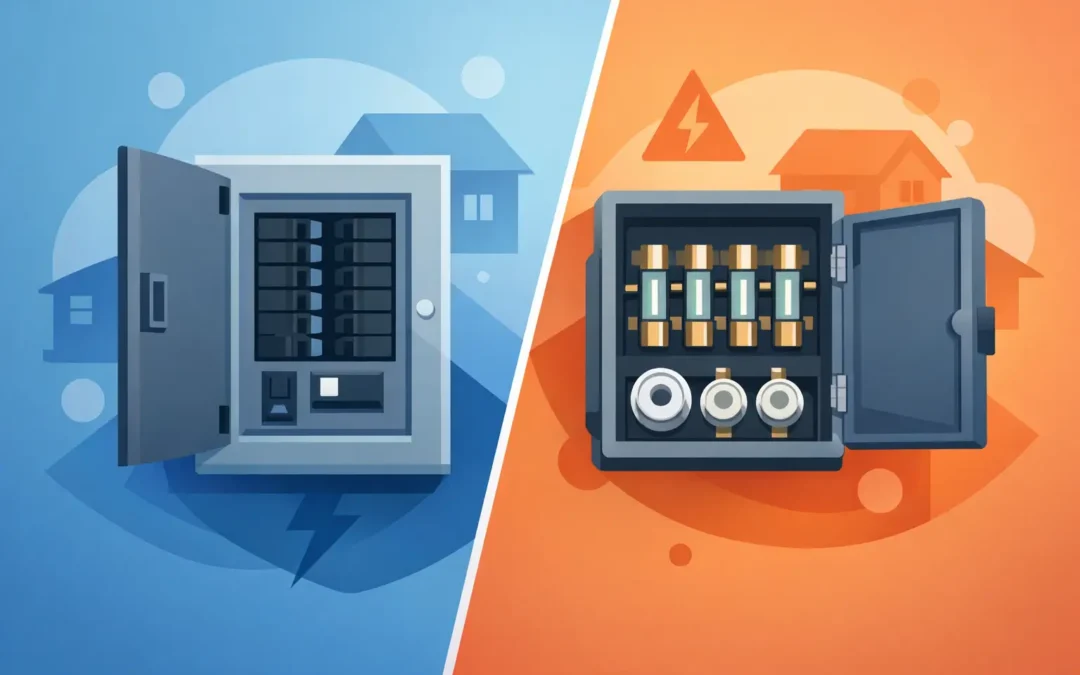
A blown fuse during a busy workday or a breaker that trips every time the microwave starts is more than an inconvenience. When comparing a breaker panel vs fuse box, the practical question is whether your electrical system can safely support the way you use the property now, not the way it was used decades ago.
Fuse boxes are still found in many older homes and small commercial spaces. They are not automatically unsafe, but they can create capacity, maintenance, and insurance concerns. A modern breaker panel is usually easier to operate, expand, inspect, and protect. The right decision depends on the age and condition of the equipment, the building’s electrical demand, and whether renovations or new equipment are planned.
Breaker Panel vs Fuse Box: The Core Difference
Both systems distribute electricity from the service entrance to individual circuits throughout a building. Both are designed to stop electrical flow when a circuit draws more current than its wiring can safely handle. The difference is in how they respond to that overload.
A circuit breaker is a switch that trips open when it detects an overload, short circuit, or certain ground-fault conditions. Once the underlying issue is corrected, the breaker can generally be reset. The panel also gives occupants a clear central location to shut off a circuit or the full electrical service when needed.
A fuse contains a metal element that melts when too much current passes through it. Once it blows, it must be replaced with a new fuse of the correct rating and type. This can be reliable protection when the fuse box is in good condition and the right fuses are always used. The concern is that replacement is manual, and incorrect fuses can defeat the protection the circuit needs.
In simple terms, breakers are reusable protective switches. Fuses are one-time protective devices. Neither should be treated as the problem itself. If either one keeps opening or blowing, it is signaling an electrical issue that should be investigated.
Why Breaker Panels Are Usually the Better Long-Term Choice
Most property owners choose a breaker panel when upgrading an older electrical system because it offers practical advantages for modern electrical use. A breaker can be reset without opening the panel or handling replacement parts. Circuit labels are usually easier to organize, and breakers make it simpler for an electrician to test, isolate, and service a circuit.
Modern panels can also accommodate protective devices that older fuse boxes generally cannot support in the same convenient way. Ground-fault circuit interrupters, or GFCIs, help protect people in areas exposed to moisture, such as bathrooms, kitchens, garages, and outdoor locations. Arc-fault circuit interrupters, or AFCIs, are designed to detect certain dangerous arcing conditions that could lead to fire. Requirements vary by location and project scope, but these protections are common in modern residential work.
Capacity is another major consideration. Older fuse boxes may have limited room for additional circuits and may be connected to lower-capacity service equipment. That becomes a problem when a property adds central air conditioning, electric heating, a finished basement, commercial equipment, a hot tub, or an EV charger. Even if the fuse box is functioning, it may not have the service capacity or panel space needed for the upgrade.
A breaker panel is not automatically the answer to every electrical issue. A newer panel with poor connections, overloaded circuits, corrosion, or improper work still needs repair. But for most older properties, a properly sized and professionally installed breaker panel provides a more flexible foundation for future electrical needs.
Where Fuse Boxes Create Risks
The biggest issue with a fuse box is not that it uses fuses. It is misuse, deterioration, and limitations that tend to develop over time.
A common concern is overfusing. If a 15-amp fuse keeps blowing, someone may install a 20-amp or 30-amp fuse to stop the nuisance. That can allow wiring designed for a lower current rating to overheat before the fuse opens. The lights may stay on, but the circuit protection has been compromised. This is a serious fire risk and should be corrected by a licensed electrician.
Older screw-in fuse boxes can also be vulnerable to damaged sockets, loose connections, heat buildup, and missing covers. Some panels contain obsolete components or have been altered over the years without permits or proper inspection. In commercial settings, an aging fuse system can also make troubleshooting slower when a circuit fails and operations need to resume quickly.
Another issue is availability. While many standard fuses can still be found, matching the correct fuse type, rating, and time-delay characteristics is not always straightforward for a property owner. Replacing a fuse with whatever is available is not a safe solution.
Insurance can be a factor as well. Some insurers may request an electrical inspection, require repairs, or place conditions on coverage for homes with certain older electrical systems. A fuse box does not guarantee an insurance problem, but it is worth confirming requirements before purchasing a property, starting a major renovation, or renewing coverage.
Signs It Is Time to Consider an Electrical Upgrade
A fuse box should be assessed based on its condition and the property’s electrical demand. If it is clean, correctly fused, undamaged, and serving a modest load, an electrician may recommend targeted repairs rather than immediate replacement. On the other hand, several warning signs point toward a panel and service upgrade.
Consider booking an inspection if fuses blow repeatedly, lights dim when appliances start, outlets feel warm, the panel has rust or visible damage, or you rely heavily on extension cords and power bars. A lack of available circuits is also a clear sign. Running a new appliance, office area, or basement renovation from an already crowded circuit is not a dependable long-term plan.
Upgrades should also be considered before adding high-demand equipment. An EV charger, electric range, heat pump, electric water heater, workshop equipment, or commercial machinery may require new dedicated circuits and a load calculation. The load calculation determines whether the existing service can safely handle the added demand. It is not enough to see an unused spot or install a larger fuse or breaker.
For older Toronto and GTA homes, panel upgrades often come up during kitchen renovations, basement finishing, and EV charger installation. The work may involve replacing the panel, upgrading the service equipment, adding circuits, improving grounding and bonding, and arranging required permits and inspections. The exact scope should be based on a site assessment, not a guess from the age of the house alone.
What a Professional Inspection Should Check
A proper assessment looks beyond whether electricity is currently working. A licensed electrician should inspect the service size, panel condition, circuit protection, visible wiring, grounding and bonding, available capacity, and signs of overheating or previous improper work.
For a fuse box, the inspection should confirm that fuse ratings match the conductors they protect and that no oversized or bypassed fuses are present. The electrician should also identify whether the panel can safely accept any planned additions. In a breaker panel, they will look for loose connections, damaged breakers, crowded wiring, corrosion, missing knockouts, and circuits that do not match their labels.
This inspection is especially useful before buying an older property. A fuse box may be manageable, or it may be the visible part of a larger issue involving undersized service equipment or aging wiring. Getting a clear scope before closing or renovating helps avoid unexpected costs and delays.
Do Not Reset or Replace Protection Without Finding the Cause
A breaker that trips once after a temporary overload may simply need to be reset. A fuse that blows after too many appliances are plugged into one circuit may have done its job. Repeated failures are different. They can indicate an overloaded circuit, a failing appliance, damaged wiring, a loose connection, water intrusion, or a short circuit.
If a breaker will not reset, trips immediately, feels hot, makes buzzing sounds, or has a burning odor nearby, leave it off and call an electrician. The same applies to a fuse box with heat, discoloration, crackling, or recurring blown fuses. Do not install a larger fuse, force a breaker on, or keep resetting a circuit until it holds.
Eclipse Electrical Services can inspect older fuse boxes, troubleshoot recurring electrical faults, and complete panel upgrades for homes and businesses across Toronto and the GTA. A clear assessment gives you the information to repair what is needed now and plan confidently for what the property will need next.
If your electrical system is asking for attention, treat that warning as useful information rather than a nuisance. A licensed inspection can turn an uncertain fuse box or overloaded panel into a clear, practical plan for safer power.