
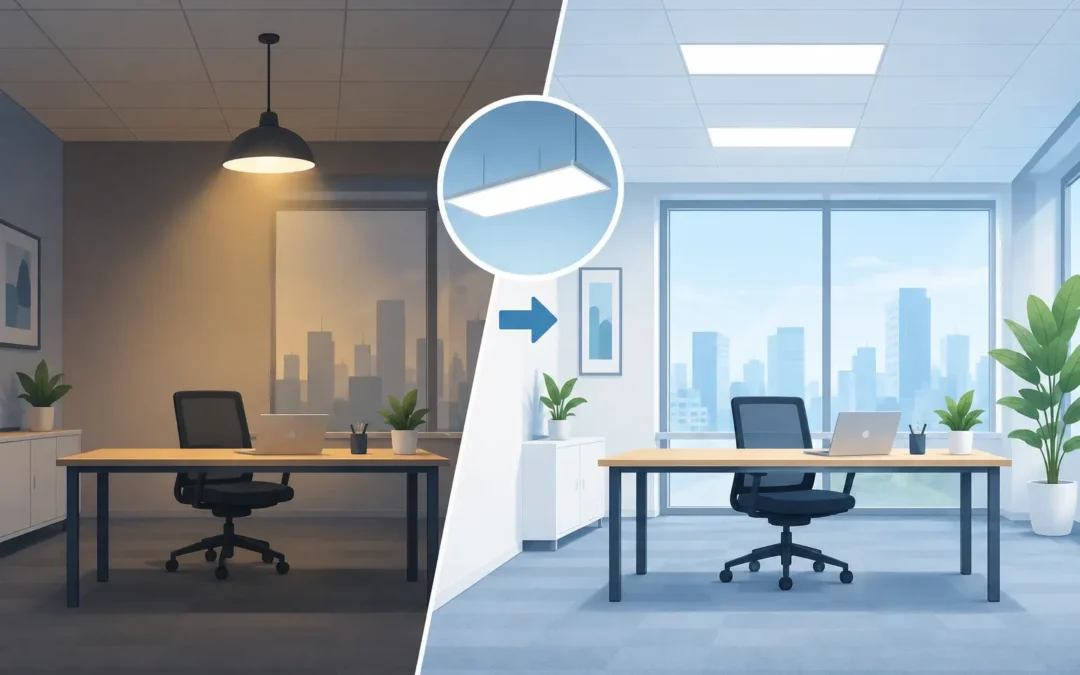
A dim reception area, flickering fixtures over workstations, and meeting rooms with harsh overhead glare are not minor maintenance issues. They affect how employees work, how customers view your business, and how much energy your building uses every month. This office lighting upgrade guide helps business owners, property managers, and facility teams plan a practical upgrade without overlooking electrical capacity, lighting quality, or safety requirements.
A good lighting project is not simply a matter of replacing old bulbs with LEDs. The right result depends on the room, the work being done there, existing wiring, ceiling type, controls, and operating schedule. A licensed electrician can assess the full system and recommend upgrades that make sense for your building and budget.
Start Your Office Lighting Upgrade With the Right Goals
Before selecting fixtures, identify what needs to improve. Some offices need lower power consumption. Others have complaints about headaches, screen glare, shadows over desks, or areas that feel unwelcoming to visitors. In older commercial units, frequent lamp and ballast failures may be the main reason for an upgrade.
Walk through the office at different times of day and make note of dark spots, overly bright zones, flickering fixtures, and lights that remain on in empty rooms. Include reception areas, open offices, private offices, meeting rooms, washrooms, hallways, storage areas, kitchens, and exterior entrances. Each space has different lighting needs.
It also helps to review your current electrical and maintenance costs. Older fluorescent fixtures may use more energy than modern LED alternatives, but energy savings should not be the only decision factor. A low-cost fixture that produces glare or poor color quality can create a new problem rather than solve the existing one.
Why LED Is Usually the Best Office Lighting Upgrade
LED lighting has become the standard choice for most office renovations and commercial fit-outs because it uses less electricity, lasts longer than many legacy lamp types, and offers better control over light output. Modern LED fixtures are available in panels, troffers, linear fixtures, recessed downlights, track lighting, task lights, and exterior wall packs.
For a typical office, replacing fluorescent troffers with quality LED panels or LED retrofit kits can reduce maintenance demands and give the ceiling a cleaner appearance. LEDs reach full brightness immediately and generally perform better in areas where lights are switched on and off throughout the day.
That said, not every LED product is equal. Very inexpensive fixtures may have poor drivers, inconsistent color, limited warranty coverage, or a higher risk of early failure. For a commercial space, choosing reliable equipment and having it installed correctly is often less expensive over the life of the system than replacing bargain fixtures repeatedly.
Choose Color Temperature for the Space
Color temperature changes the feel of a room. It is measured in Kelvin, and the right choice depends on the setting.
Warm white lighting, often around 3000K, can work well in reception spaces, lounges, and client-facing areas where a more comfortable atmosphere is preferred. Neutral white lighting around 3500K to 4000K is a common fit for offices, meeting rooms, and work areas because it appears clean without feeling overly cold. Higher color temperatures can suit detail-focused workspaces, warehouses, or utility areas, but they can look harsh in a customer-facing office.
Consistency matters as much as the selected temperature. Mixing noticeably warm and cool fixtures in the same open area can make a finished installation look unplanned.
Do Not Ignore Color Rendering and Glare
Color rendering affects how accurately people see colors under artificial light. This matters in offices with printed materials, samples, merchandise, design work, or video calls. A higher-quality fixture with good color rendering can make people, finishes, and documents look more natural.
Glare is another common issue. Light that is too direct, too bright, or poorly positioned can reflect off computer monitors and polished desks. In open-plan offices, fixture placement should support screen work rather than create bright reflections above every workstation. Diffused LED panels, indirect lighting, and thoughtful layout planning can make a major difference.
Plan Lighting by Zone, Not by One Fixture Type
A practical office lighting upgrade guide should treat each area as its own zone. Using the same fixture and switching arrangement everywhere is easy, but it rarely gives the best performance.
Reception and waiting areas need lighting that feels professional and welcoming. Open work areas need even illumination with minimal glare. Meeting rooms need flexible lighting for presentations, video calls, and note-taking. Washrooms, corridors, storage rooms, and utility spaces often benefit from occupancy sensors because lights are not needed continuously.
Private offices may need a combination of general overhead lighting and task lighting. This gives employees control at their desk without requiring the entire room to be brighter than necessary. For offices with windows, daylight should also be considered. A bright exterior wall may need less artificial light during the day than an interior workspace with no access to natural light.
Add Lighting Controls Where They Will Actually Save Money
Lighting controls can improve convenience and reduce wasted power, but they need to fit how the office operates. Occupancy sensors are useful in washrooms, copy rooms, storage areas, small meeting rooms, and staff kitchens. Vacancy sensors require someone to switch lights on but turn them off automatically, which can be a good choice where unwanted activation is a concern.
Timers and scheduling controls can help with exterior lighting, signage, and spaces that follow predictable business hours. Daylight harvesting controls can dim lighting near windows when natural light is available. These controls can be worthwhile in larger offices, though the savings depend on how much daylight the building receives and how the space is used.
Avoid adding sensors everywhere without a plan. In an open office where people sit quietly for long periods, poorly placed sensors can switch lights off while the room is still occupied. A proper site assessment helps determine where controls provide real value and where straightforward switching is the better option.
Check the Electrical System Before Ordering Fixtures
Lighting upgrades can expose issues that have been hidden for years. Old ballasts, damaged branch wiring, overloaded circuits, aging panels, and improper connections may need attention before new fixtures are installed. A fixture upgrade is also a good time to check emergency lighting, exit signs, and any lighting connected to backup power.
For a small retrofit, existing circuits may be suitable. For a larger office renovation, a change in layout or added fixtures may require new circuits, upgraded switching, or panel work. This is especially common when converting a warehouse, retail unit, or older commercial space into offices.
A licensed electrical contractor should verify load requirements, circuit condition, grounding, control wiring, and applicable permit requirements before work begins. This prevents costly surprises after ceilings are opened or fixtures have already been purchased.
Decide Between Retrofit Kits and New Fixtures
Retrofit kits allow an existing fixture housing to be updated with LED components. They can be a sensible option when existing troffers are in good condition and the goal is to control project costs. They may also reduce disruption in occupied offices.
New fixtures are often the better choice when housings are damaged, the existing layout does not provide enough light, appearance matters, or you want improved optical performance and controls. New LED panels and linear fixtures can create a cleaner, more modern look, particularly during tenant improvements and office fit-outs.
The right answer depends on fixture condition, ceiling layout, budget, and expected time in the space. A contractor should provide clear options rather than pushing one approach for every project.
Build a Realistic Upgrade Budget and Schedule
The fixture price is only one part of the project cost. A complete estimate should account for labor, disposal of old lamps and ballasts where required, access equipment, new wiring or controls, ceiling repairs if needed, permits, and any electrical corrections identified during the inspection.
For occupied offices, scheduling matters just as much as price. Many lighting projects can be completed after business hours, in stages, or section by section to limit disruption. A phased approach is especially useful for medical offices, customer-facing businesses, and workplaces that cannot shut down for a full day.
Ask for a scope that explains what is included, what equipment will be installed, and what happens if hidden electrical issues are found. Clear communication at the start makes the work easier to manage and reduces the chance of unexpected costs.
Work With a Licensed Commercial Electrician
Office lighting affects safety, comfort, productivity, and operating costs. It deserves more planning than a quick bulb replacement. Eclipse Electrical Services helps businesses across Toronto and the GTA assess existing lighting, install reliable LED systems, update controls, and address the electrical work behind the fixtures.
The best next step is a walkthrough of your space with a licensed electrician. Bring the problem areas, operating hours, budget range, and future plans for the office. A well-planned upgrade gives your team better light to work under and gives you an electrical system that is easier to maintain for years ahead.