
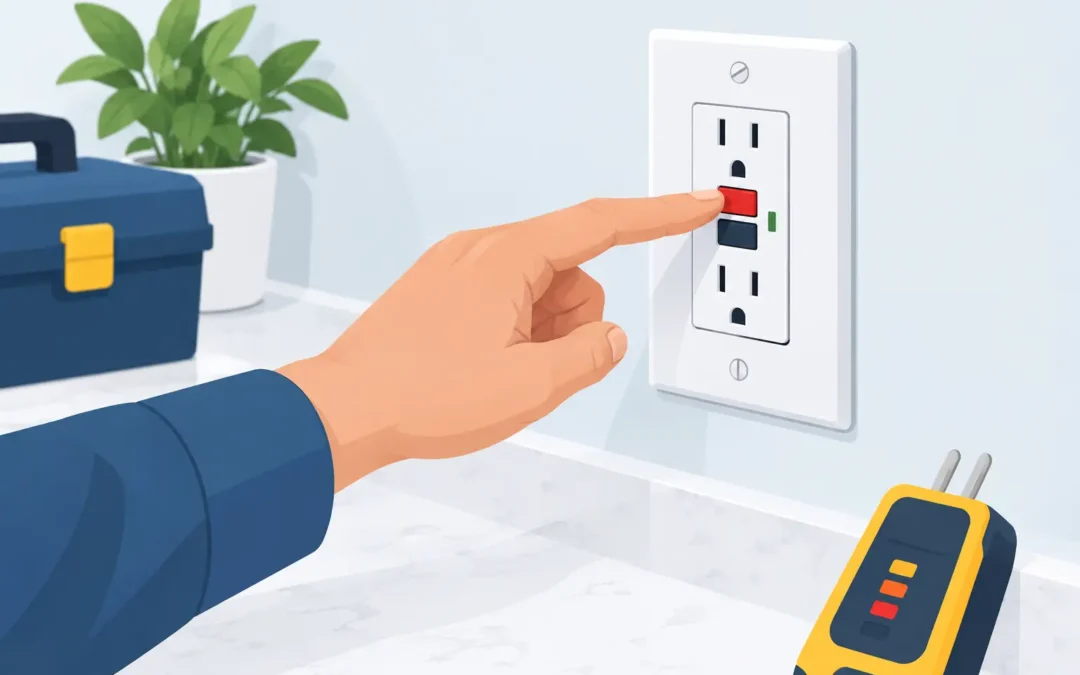
A GFCI outlet is supposed to shut power off before a ground fault becomes a serious shock hazard. That protection only helps if the device can trip and reset properly. Knowing how to test GFCI outlets takes only a few minutes, but the result can reveal a safety issue in a bathroom, kitchen, garage, basement, outdoor area, or commercial workspace.
GFCI stands for ground-fault circuit interrupter. These outlets monitor the flow of electricity and cut power very quickly when they detect current taking an unintended path, such as through water or a person. They are common wherever electricity and moisture can meet, but they may also protect outlets farther down the same circuit.
How to Test GFCI Outlets With the Built-In Buttons
Start by locating the two buttons on the face of the outlet. They are usually labeled TEST and RESET. Before pressing anything, plug in a lamp, night-light, phone charger, or another simple device that you know is working. Turn the device on so you have an easy way to confirm whether power is present.
Press the TEST button firmly. A working GFCI outlet should trip immediately, shutting off power to the device you plugged in. The RESET button may pop outward, and the lamp or charger should turn off.
Next, press the RESET button. It should click into place, and power should return to the device. This confirms that the outlet can trip and reset under a basic test.
Do not assume that only the outlet you are testing has lost power. One GFCI can protect several regular outlets downstream. After pressing TEST, check nearby outlets in the same bathroom, kitchen, garage, basement, exterior area, or work area. If they have also gone dead and return after you press RESET, that GFCI is providing protection to them.
For most homes and businesses, testing each GFCI monthly is a sensible maintenance habit. At a minimum, test them regularly and after any electrical work, flooding, water leak, or extended vacancy.
What a Successful Test Should Look Like
A normal test is straightforward: power is on, pressing TEST cuts power, and pressing RESET restores it. If all three steps happen consistently, the outlet has passed its basic function check.
Many newer GFCI outlets include a small status light. The light pattern varies by manufacturer, so check the markings on the device or its instructions if they are available. A red or flashing indicator can mean the outlet has reached the end of its service life, has been wired incorrectly, or will not provide protection. Do not rely on color alone, since different models use different indicator systems.
A basic button test does not inspect every part of the circuit. It does not confirm that all wiring connections are sound, that the outlet is properly grounded, or that the circuit has enough capacity for the equipment being used. It does tell you whether the GFCI’s own trip and reset mechanism responds, which is an essential first check.
Using a Plug-In GFCI Tester
A plug-in outlet tester can provide an additional check. These inexpensive devices have indicator lights that can identify common wiring conditions, such as an open ground, open neutral, or reversed polarity. Many models also have a button that simulates a ground fault.
Plug the tester into the GFCI outlet and compare the light pattern with the chart printed on the tester. If the pattern shows normal wiring, press the tester’s button. The GFCI should trip and cut power. Then press RESET on the outlet to restore power.
This method is useful, but it has limits. A plug-in tester is not a full electrical inspection tool, and its results can be misleading on older two-wire circuits, circuits without an equipment ground, or circuits with more complex wiring problems. If the tester indicates an issue, do not try to correct outlet wiring based on the lights alone. Shut off the circuit if there is any sign of damage and have a licensed electrician diagnose it.
When a GFCI Outlet Fails the Test
A GFCI that does not trip when you press TEST should be treated as a safety concern. It may be worn out, improperly connected, or not receiving power correctly. It should not be left in service as though it is providing ground-fault protection.
If the outlet trips but will not reset, unplug everything connected to that outlet and to nearby outlets that may be on the same protected circuit. Then try RESET once more. A connected appliance, extension cord, outdoor device, water exposure, or fault farther down the circuit can prevent a GFCI from resetting.
If it still will not reset, stop there. Repeatedly forcing the reset button can mask an active electrical problem and will not repair the cause. A licensed electrician can test the circuit safely and determine whether the problem is the GFCI device, a downstream outlet, a damaged cable, moisture intrusion, or another circuit fault.
Warning Signs That Need Professional Service
Turn the power off at the breaker if it is safe to do so, and arrange service promptly if you notice any of the following:
- The GFCI outlet feels warm, makes buzzing or crackling sounds, or has a burning smell.
- The faceplate is cracked, discolored, loose, wet, or shows signs of arcing.
- The outlet trips repeatedly with nothing plugged into it.
- The outlet will not trip during a test, will not reset, or loses power unpredictably.
- Nearby outlets lose power and you cannot identify or reset the protecting GFCI.
Water and electricity are a particularly serious combination. Do not test, reset, or use a wet outlet. If an outlet has been exposed to a leak, flood, heavy condensation, or outdoor water intrusion, leave it alone until it has been assessed by a qualified electrician.
Common Places People Forget to Check
Homeowners often remember the bathroom and kitchen outlets but overlook GFCIs in garages, unfinished basements, laundry rooms, utility rooms, crawl spaces, exterior receptacles, and near wet bars. In commercial properties, janitor closets, kitchens, mechanical rooms, wash areas, loading zones, and exterior service outlets also deserve attention.
The protecting GFCI is not always in the same room as the outlet that has gone dead. A garage outlet may be protected by a GFCI in a bathroom, basement, utility room, or electrical area. Before assuming an outlet has failed, check other GFCIs around the property and reset only the one that has tripped. If you cannot identify the protecting device, electrical troubleshooting is the safer next step.
Do Not Confuse a GFCI With a Circuit Breaker
A GFCI outlet protects people from ground-fault shock hazards. A circuit breaker is primarily designed to protect wiring from overloads and short circuits. Some electrical panels have GFCI breakers, which provide ground-fault protection to an entire circuit instead of using a GFCI receptacle at the point of use.
If your panel contains GFCI breakers, they usually have a TEST button and should be tested according to the manufacturer’s directions. Do not remove the panel cover or work inside the panel to investigate a failed test. Panel work carries a higher risk and should be handled by a licensed electrician.
A Practical Safety Habit for Your Property
Set a recurring reminder to test GFCI outlets, especially before outdoor season, after renovations, and whenever a property has had water issues. Keep the test simple: use a working lamp, press TEST, confirm power is off, press RESET, and confirm power returns.
If an outlet fails any part of that process, do not guess at the repair. Eclipse Electrical Services can inspect GFCI protection, trace affected outlets, and complete the repair safely for homes and businesses throughout Toronto and the GTA. A quick test today can catch a small issue before it becomes a failed outlet, an unexpected shutdown, or a preventable electrical hazard.