
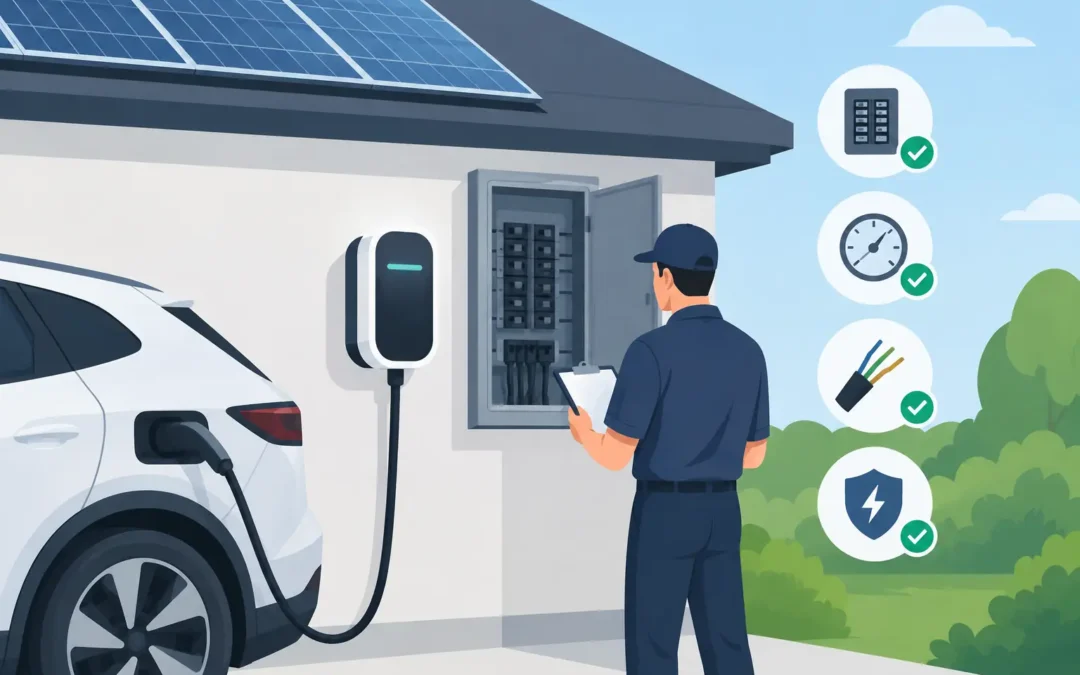
A new EV charger can be one of the largest electrical loads in a home or business. So, can panels support EV chargers? Sometimes the answer is yes with a new breaker and proper wiring. Other times, the panel has no physical space, the electrical service is already heavily loaded, or the existing equipment needs an upgrade before charging can be installed safely.
The right answer comes from an on-site electrical assessment, not a quick look at the panel door. A licensed electrician needs to confirm breaker capacity, available load, wiring requirements, equipment condition, and the charging speed you actually need. That approach prevents nuisance tripping, overloaded equipment, and costly changes after installation begins.
Can Panels Support EV Chargers Without an Upgrade?
Many properties can support an EV charger without replacing the main panel. A newer 200-amp residential service with available breaker spaces often has enough capacity for a Level 2 charger, especially when the home uses gas heat, gas water heating, and gas cooking.
But panel amp rating alone does not settle the question. A 200-amp panel may already serve electric heating, central air conditioning, an electric range, dryer, hot tub, pool equipment, workshop tools, or a finished basement suite. Those loads need to be considered together. The goal is not to add up every appliance nameplate and assume the panel is overloaded. Electricians perform a load calculation that accounts for how electrical loads are expected to operate in real conditions.
A smaller 100-amp service can also support EV charging in some homes. It depends on the existing demand and the charger output. A modest charger may be practical where a high-output 48-amp unit is not. In other cases, a 100-amp service is already close to its useful limit and a service upgrade is the safer long-term choice.
For commercial properties, the question is broader. The building’s main service, tenant panel, transformer capacity, operating hours, existing machinery, and plans for future chargers all matter. One charger for an employee vehicle is very different from a bank of chargers for a fleet, condominium, or customer parking area.
The Three Things an Electrician Checks First
The first check is physical breaker space. A Level 2 charger normally needs a dedicated 240-volt circuit, typically using a double-pole breaker. If every breaker position is occupied, there may be options such as reorganizing circuits, using approved panel equipment, installing a subpanel, or replacing the panel. Not every crowded panel requires a full service upgrade, but no one should force an additional circuit into equipment that is not designed for it.
The second check is electrical capacity. The electrician calculates the expected demand from lighting, receptacles, appliances, heating and cooling equipment, and other fixed loads. EV charging is generally treated as a continuous load because it can run for several hours. That means the circuit and equipment must be sized with additional capacity rather than right at their maximum rating.
The third check is the condition of the equipment. Older panels, corrosion, loose connections, damaged breakers, unmarked circuits, overheating, or obsolete equipment can change the scope of work. Installing an EV charger is a good time to address problems that may have gone unnoticed. A charger should be connected to safe, properly functioning equipment, not used as a reason to stretch aging electrical gear beyond its limits.
Charger Size Has a Major Effect on Panel Requirements
Not every EV charger draws the same amount of power. Level 1 charging uses a standard household outlet and charges slowly. It may be suitable for low daily mileage, plug-in hybrids, or a vehicle that sits parked for long periods. It is not always convenient for drivers who need to recover significant range overnight.
Level 2 charging is the common choice for homes and businesses because it provides faster charging from a 240-volt circuit. However, the required circuit can vary substantially. A charger set to 16 amps has a very different impact on the electrical system than one set to 40 or 48 amps.
This creates a useful trade-off. The largest charger is not automatically the best charger. If a property can safely support a 32-amp charger without a costly upgrade, that may provide more than enough overnight charging for the driver’s routine. If the household expects a second EV, plans to electrify heating, or wants faster turnaround, investing in panel or service capacity can make better sense.
An electrician can help match charger output to the vehicle, daily driving distance, parking time, and available electrical capacity. That avoids paying for charging power the property cannot use or the driver does not need.
When a Panel Upgrade Is the Right Move
A panel upgrade may be recommended when the existing panel is full, undersized, deteriorated, or unable to pass a proper load calculation with the proposed charger. It can also be the practical choice when a renovation is already planned or when the property is adding other major electrical loads, such as a heat pump, electric water heater, induction range, sauna, or additional dwelling space.
There is a difference between a panel upgrade and a service upgrade. A panel replacement may provide more circuit space and modern breakers while keeping the same service capacity. A service upgrade can involve larger conductors, a new meter base, utility coordination, grounding updates, and a higher main service rating. The correct scope depends on what is limiting the installation.
For a business, future growth is especially worth considering. Installing infrastructure for one charger may be inexpensive today but difficult to expand later if conduit pathways, distribution capacity, or parking-lot access are not planned properly. A phased design can provide immediate charging while allowing for additional stations when demand increases.
Load Management Can Be a Practical Alternative
Load management equipment can allow an EV charger to operate without overloading the electrical service. These systems monitor the building’s demand and reduce or pause charging when other electrical use is high. When demand drops, the charger resumes at its available setting.
This option can be particularly useful in homes with limited service capacity and in commercial settings where a full electrical upgrade would be expensive or disruptive. It is not a shortcut around proper design. The equipment must be approved, installed correctly, and selected for the specific service and charger.
Smart charging can also help manage operating costs where electricity rates vary by time of day. Scheduling the vehicle to charge overnight may reduce cost and lower demand during busy household or business hours. Still, rate scheduling does not replace a load calculation or make an undersized panel safe.
Installation Details That Affect the Final Scope
Panel capacity is only part of an EV charger installation. The distance from the panel to the parking location affects conductor size, conduit routing, labor, and cost. A charger in an attached garage may be straightforward. A detached garage, underground parking space, exterior pedestal, or commercial lot can require trenching, concrete work, fire-rated penetrations, longer conduit runs, and coordination with building management.
Permitting and inspection requirements should also be handled properly. Electrical work for EV charging should be performed by a licensed contractor who can size the circuit correctly, install the required protection, and ensure the work meets applicable electrical rules. DIY installations and improvised outlet connections can create fire, shock, and equipment-damage risks.
For condominiums and leased commercial spaces, approval is often needed before work begins. The property owner or manager may have requirements for metering, parking assignments, common-area electrical capacity, insurance, and future expansion. Addressing those details early prevents a charger project from stalling after the electrical work has been priced.
Get an Answer Before Choosing the Charger
The best time to assess panel capacity is before ordering a charger. A licensed electrician can review the service, perform the required load calculation, inspect the panel, and explain whether the property needs a dedicated circuit, subpanel, load management system, panel upgrade, or service upgrade.
Eclipse Electrical Services helps homeowners and property operators across Toronto and the GTA plan EV charger installations around the electrical system they already have. A clear assessment gives you practical options, accurate pricing, and a charging setup that is safe for the long haul.
If your panel is already carrying a heavy load, that does not mean EV charging is out of reach. It means the installation should be designed around the property instead of forcing the property to fit the charger.