
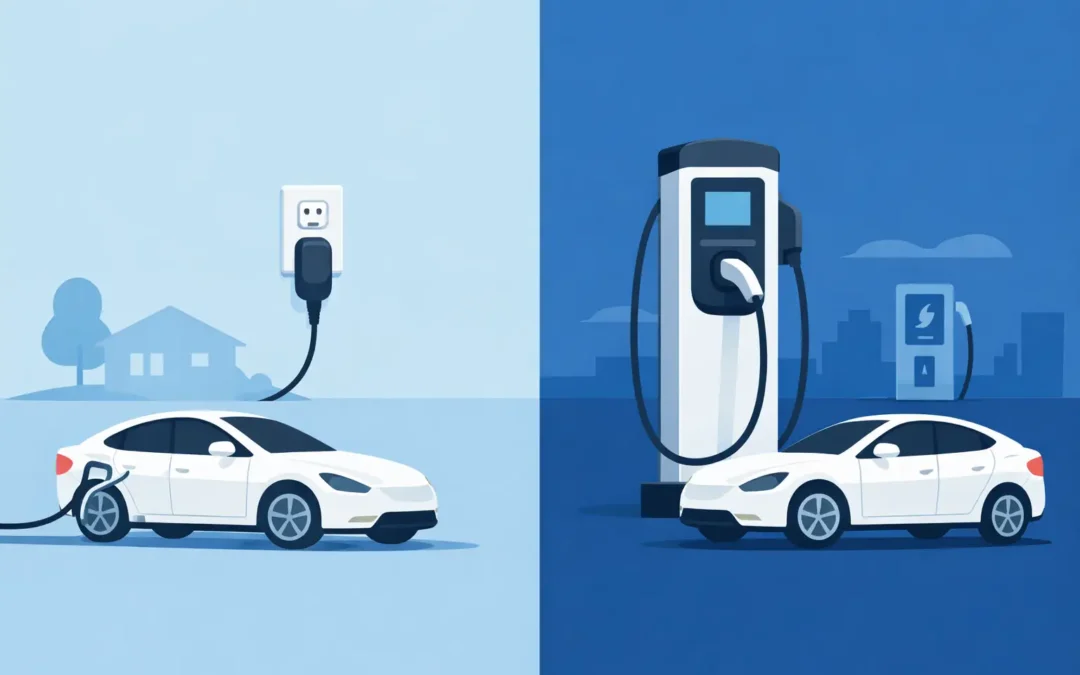
You usually notice the difference between charging levels the first time an EV battery runs low at the wrong moment. Plugging into a standard wall outlet may be enough for one driver, while another needs a much faster setup just to keep up with the week. That is why the level 1 vs level 2 charger question matters – not as a technical detail, but as a real decision that affects convenience, installation cost, and daily use.
For most property owners, the right choice comes down to driving habits, electrical capacity, and whether you want the simplest option or the most practical long-term setup. A charger that looks cheaper upfront can become frustrating if it cannot recover enough range overnight. On the other hand, a faster charger is not always the smart pick if your usage is light and your panel would need major upgrades.
Level 1 vs level 2 charger: the basic difference
A Level 1 charger uses a standard 120-volt household outlet. In most cases, this is the slowest way to charge an EV at home. It is often the charging cord that comes with the vehicle, so there may be little or no upfront equipment cost beyond using an existing outlet.
A Level 2 charger uses a 240-volt circuit, similar to what larger appliances use. It charges much faster and is the more common choice for dedicated home charging and many commercial installations. The trade-off is that Level 2 usually requires professional installation, proper circuit sizing, and sometimes an electrical panel review before the work begins.
The difference in charging speed is what drives most decisions. Level 1 often adds only a few miles of range per hour. Level 2 can add several times that amount, which makes a big difference if the vehicle is driven daily, used for business, or needs to be ready on a tighter schedule.
How charging speed affects real-world use
On paper, speed sounds simple. In practice, it depends on how often the vehicle is driven and how much battery you need to replace overnight.
If you drive short local trips and the car sits parked for long stretches, Level 1 may be enough. A homeowner who drives 20 to 30 miles a day and can leave the vehicle plugged in every night may find that a standard outlet keeps pace. It is not fast, but for light use, it can work.
That changes quickly for commuters, multi-driver households, and businesses. If the vehicle covers longer distances each day, or if it needs to be turned around quickly, Level 1 can become too slow. You may finish one day already behind on charging and start the next with less range than you need.
Level 2 is built for that reality. It is better suited for drivers who want dependable overnight charging, property managers planning for tenant demand, or commercial operators who need vehicles ready without delay. It also gives more flexibility if driving patterns change later.
When Level 1 makes sense
Level 1 is not a bad option. It is just limited.
It makes sense when the electrical setup is simple, the driving load is low, and the goal is to start charging without major installation work. For someone testing out EV ownership, Level 1 can be a practical starting point. It also works in temporary situations, such as a renter using an available outlet with permission and without modifying the property.
There are still a few concerns to keep in mind. The outlet must be in good condition and on a circuit that can handle sustained charging. Extension cords are generally not a good idea for EV charging. If the outlet is old, loose, or shared with other loads, that needs to be addressed before relying on it regularly.
This is where property owners sometimes underestimate the electrical side. Even a slower charger draws power for long periods, so safety matters. A licensed electrician can confirm whether the outlet and circuit are suitable or if upgrades are needed.
When Level 2 is the better investment
Level 2 is the better fit when convenience, speed, and reliability matter more than the lowest upfront cost.
For many homeowners, this is the point where EV charging stops feeling like a workaround and starts feeling easy. You come home, plug in, and the vehicle is typically ready by morning. That simplicity matters more than people expect, especially during busy workweeks or winter months when battery use can be less forgiving.
For businesses and commercial properties, Level 2 is often the practical minimum. Staff vehicles, fleet use, customer charging, and tenant expectations all push toward faster charging. A standard outlet usually does not meet those demands in a useful way.
There is also a future-proofing angle. If you already know the property will support more EV use later, a Level 2 installation can be part of a smarter electrical plan. That may include load calculations, panel upgrades, dedicated circuits, or planning for additional chargers down the road.
Installation costs and electrical requirements
This is where the level 1 vs level 2 charger decision gets more specific.
Level 1 may cost very little if an existing outlet is already safe and properly located. But if the outlet needs replacement, the circuit has issues, or the location is inconvenient, even a basic setup can involve some electrical work.
Level 2 costs more because it usually requires a new 240-volt circuit and a professionally installed charging unit or receptacle. The final price depends on the distance from the panel, wall access, permit requirements, charger amperage, and whether the electrical service has enough capacity.
In some homes, the installation is straightforward. In others, the panel is already full or undersized, which can turn a simple charger install into a broader upgrade project. Older homes and commercial spaces often need a closer look before any quote is reliable.
That is why a proper site assessment matters. A good electrician will not just price the charger. They will check panel capacity, breaker space, wiring route, and code requirements so the installation is safe and built to last.
Homeowners, landlords, and commercial properties have different needs
A single-family homeowner is usually deciding based on personal driving habits and budget. For that customer, the question is often whether Level 1 is enough for now or whether Level 2 will save time and frustration long term.
A landlord or condo property owner has a different issue. They may need a charger setup that is durable, code-compliant, and ready for multiple users over time. In that case, Level 2 is often the more useful investment because demand rarely stays small once EV adoption picks up.
Commercial properties and facility managers need to think about usage patterns, power distribution, and business continuity. A charger is not just a convenience feature. It can affect operations, tenant value, employee satisfaction, and the electrical load on the building. Choosing the wrong setup can create avoidable limitations later.
Which charger should you choose?
If your daily mileage is low, your budget is tight, and you have access to a safe, dedicated standard outlet, Level 1 may be enough. It is the simpler choice, and for some drivers, simple is all they need.
If you drive regularly, want reliable overnight charging, or are installing for a business or multi-user property, Level 2 is usually the stronger choice. It costs more upfront, but it solves the problem more completely.
The right answer depends on usage, not just equipment. A charger should match how the property actually functions. That is why the best installations start with the electrical system and the charging demand, not with a one-size-fits-all recommendation.
At Eclipse Electrical Services, we see this decision the same way we approach any electrical job: get clear on what the property needs, install it safely, and avoid pushing customers into more than they actually require. If you are weighing speed, cost, and electrical capacity, a licensed assessment will usually tell you very quickly whether Level 1 is enough or Level 2 is the smarter move.
A charger should make your day easier, not add another thing to work around.