
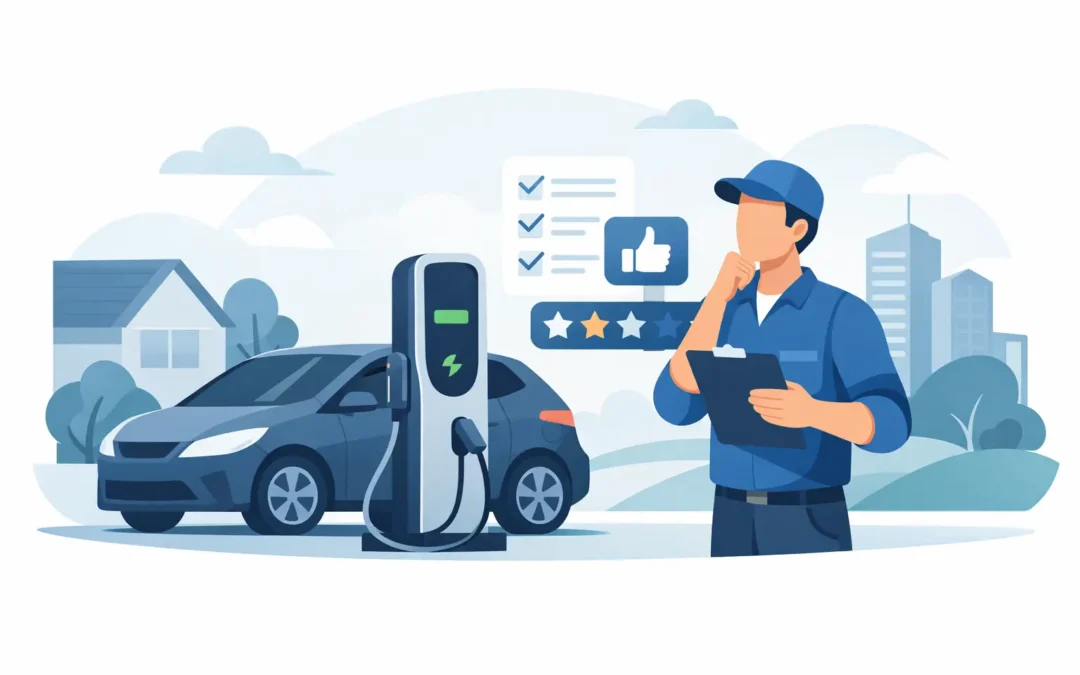
A low install quote can look great right up until the charger trips breakers, charges slower than expected, or fails inspection. That is why an EV charger installer review should focus on more than price alone. If you are hiring for a home, condo, retail site, or commercial property, the real question is simple: can the installer do the job safely, legally, and without creating problems later?
What an EV charger installer review should actually cover
Most people start by checking star ratings, and that is reasonable. Reviews can tell you whether an electrician showed up on time, communicated clearly, and left the site clean. But for EV charger work, that is only part of the picture.
A useful EV charger installer review should look at technical judgment, not just customer service. Installing a Level 2 charger is not the same as swapping a light fixture or adding a receptacle. The electrician needs to assess panel capacity, breaker space, wire routing, charger compatibility, code requirements, and how the charger will be used day to day. A garage wall install with a short run is one thing. A detached garage, underground parking spot, or multi-vehicle commercial setup is another.
If a review only says, “good service” or “fair price,” it does not tell you enough. The stronger reviews usually mention specifics – permit handling, panel upgrades, trenching, load calculations, clean conduit work, inspection approval, and whether the charger performed as promised after installation.
The basics that should never be skipped
The first checkpoint is licensing and insurance. That sounds obvious, but it matters even more with EV charging because you are adding a continuous electrical load. A licensed electrical contractor should be able to explain the scope clearly, pull permits when required, and complete the work to code.
The second is experience with EV chargers specifically. Good electricians can handle a wide range of work, but EV charging has its own common issues. Load management, breaker sizing, charger settings, and manufacturer requirements all affect performance. An installer who regularly handles EV charger jobs will spot problems earlier and offer better options.
The third is site assessment. If a contractor gives a firm quote without asking about your panel, service size, charger model, parking layout, or cable route, that is a warning sign. Some installs are straightforward. Others need a subpanel, service upgrade, longer run, or a different charger location to keep the job safe and cost-effective.
Price matters, but so does what the quote includes
A lot of frustration starts with incomplete pricing. One contractor quotes a low number, another comes in higher, and it looks like an easy decision. Then the change orders start.
A proper EV charger quote should spell out what is included. That means labor, materials, breaker and wiring specs, mounting hardware, conduit where needed, permit responsibility, and whether patching or surface restoration is part of the job. If a panel upgrade might be required, that should be discussed up front rather than introduced halfway through the install.
There is also a difference between a fair price and a cheap job. If the installer is rushing the site review, avoiding permit questions, or being vague about load capacity, the lower quote may not be the better value. Paying a little more for clear workmanship, proper approvals, and fewer callbacks usually saves money over time.
Why panel capacity is one of the biggest review points
This is where many installs are won or lost. The charger itself may be excellent, but if the electrical service cannot support it properly, performance and safety both suffer.
A strong installer review should mention whether the electrician checked panel capacity and explained the available options. In some homes, there is enough space and service to add a dedicated EV circuit without much trouble. In others, especially older properties, the panel is already carrying a heavy load from HVAC, appliances, and general use.
That does not always mean a full service upgrade is required. Sometimes load management equipment or a lower-amperage charger is the smarter choice. Sometimes a panel upgrade is the right answer because the property will need more capacity in the near future anyway. The point is that a good installer does not force one solution onto every property. They explain the trade-offs and recommend what fits the building and the budget.
Residential installs and commercial installs are not reviewed the same way
For homeowners, the main concerns are usually convenience, charging speed, finish quality, and cost. People want the charger placed where it is easy to use, with wiring that looks tidy and does not create an eyesore in the garage or on the side of the house. They also want confidence that the charger will work reliably through daily use and changing weather.
For commercial properties, the review criteria widen quickly. A business owner or facility manager may need multiple chargers, controlled access, usage tracking, load balancing, future expansion, and minimal downtime during installation. The electrical contractor also needs to coordinate with site operations, other trades, landlords, or property management.
That is why the best review is always context-specific. A contractor who is excellent for a single-family garage install may not be the right fit for a retail plaza, warehouse, office property, or fleet charging project. The reverse can also be true. Bigger is not always better if your job is simple and you want quick, practical service.
Signs of a reliable installer before the job starts
You can learn a lot before anyone picks up a tool. Clear questions are a good sign. So is a straightforward explanation of the work. A dependable installer should ask about your vehicle, charger choice, panel location, parking layout, and how quickly you need the job done.
They should also be honest about complications. If your preferred charger location means a long cable run and extra conduit, they should say so. If your panel is close to full, they should explain the options instead of hoping it works out on install day. If permits or inspections will affect timing, that should be discussed from the start.
Responsiveness matters too. Electrical work often moves on a schedule tied to renovations, vehicle delivery, tenant turnover, or business operations. Slow replies and vague timelines early on usually do not improve once the job begins.
Red flags that deserve attention in any EV charger installer review
Some warning signs come up again and again. One is a contractor who treats the charger like a simple plug-in appliance rather than a dedicated electrical installation. Another is pressure to skip permits or inspections in order to save time or money.
You should also be cautious if the installer cannot clearly explain breaker sizing, load considerations, or the difference between charger models. That does not mean you need a technical lecture. It means they should be able to answer normal questions in plain language.
Poor documentation is another issue. If the estimate is thin, the scope is unclear, or verbal promises keep replacing written details, disputes become more likely. Good contractors do not make the process complicated, but they do make it clear.
What strong workmanship looks like after installation
The charger should work, of course, but that is the minimum. The better install is neat, code-compliant, and practical to use. The charger is mounted at a sensible height, the cable reach makes sense for the vehicle, the conduit is installed cleanly, and labeling is handled properly where required.
You should also receive a basic handoff. That means knowing how to operate the charger, what circuit it is on, what to do if a breaker trips, and whether there are manufacturer settings that need adjustment. On a commercial site, handoff may also include user access setup, network features, and load-sharing configuration.
This is one place where a dependable local contractor stands out. The job is not finished when the charger turns on for the first time. It is finished when the system is safe, approved, and ready for real use.
The best review is the one that matches your property
If you are reading an EV charger installer review, treat it as a filter, not a final answer. Look for evidence that the contractor understands your type of property and your type of demand. A condo parking space, a detached garage, a small business lot, and an industrial site all bring different requirements.
The right installer is usually the one who keeps the process simple without oversimplifying the work. They ask the right questions, price the job honestly, complete it to code, and do not disappear when you need follow-up. That is the standard practical customers should expect.
For property owners who want fast, licensed electrical work without guesswork, that matters more than a flashy sales pitch. A charger install is not just another add-on. It is part of your building’s electrical system, and it should be treated that way from the first call onward.
A good hiring decision usually comes down to one thing: choose the electrician who makes the job feel clear, safe, and properly handled before the install even begins.