
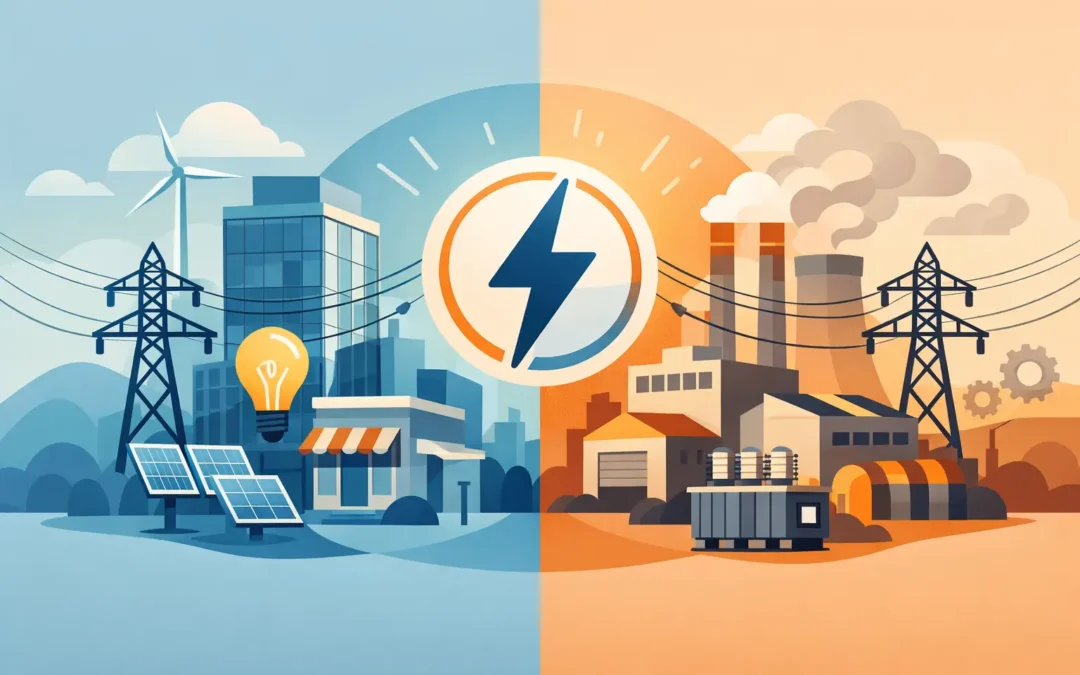
If you are planning electrical work for a business property, the difference between commercial and industrial electricity matters more than most people expect. It affects everything from the type of service you need to the equipment your building can support, how maintenance is handled, and what kind of electrician should be doing the work.
For a storefront, office, restaurant, warehouse, or manufacturing site, electrical systems are not interchangeable. A commercial setup is built around serving people, lighting, HVAC, technology, and customer-facing operations. An industrial setup is built around powering heavy machinery, production processes, motors, control systems, and equipment that may run hard for long hours. That difference changes the design, load demands, safety planning, and cost of the work.
What is the difference between commercial and industrial electricity?
At a basic level, commercial electricity serves businesses like retail stores, offices, schools, restaurants, medical clinics, and mixed-use buildings. These systems are designed to support lighting, computers, point-of-sale systems, refrigeration, HVAC equipment, elevators, security systems, and day-to-day business operations.
Industrial electricity serves facilities such as factories, processing plants, manufacturing sites, large distribution centers, and operations that rely on heavy-duty equipment. These systems are built for larger power loads, more complex distribution, motor controls, automation, and equipment that often runs continuously or in demanding cycles.
So when people ask about the difference between commercial and industrial electricity, the real answer is not just about building type. It is about how electricity is used, how much power is required, how the system is engineered, and how much downtime the operation can tolerate.
Commercial electrical systems are built for business operations
In a commercial property, the electrical system is usually centered on reliability, occupancy comfort, code compliance, and efficient daily use. Offices need stable power for lighting, computers, data equipment, and heating and cooling. Restaurants need circuits for kitchen equipment, refrigeration, ventilation, and customer areas. Retail spaces need display lighting, signage, payment systems, and back-of-house power.
That does not mean commercial work is simple. Many commercial properties have demanding service requirements, especially if the building includes large HVAC units, commercial kitchens, server rooms, or tenant fit-outs. Load balancing, panel capacity, emergency lighting, surge protection, and future expansion all matter.
Commercial systems also tend to involve more branch circuits spread across a property to serve multiple rooms, tenant spaces, or business functions. Accessibility, safety for the public, and minimizing disruption during repairs or upgrades are usually major priorities.
Industrial electrical systems are built for heavy loads and continuous use
Industrial facilities are a different environment altogether. The electrical infrastructure often has to support high-voltage service, large motors, conveyors, pumps, compressors, process equipment, control panels, and machinery that places sustained demand on the system.
Instead of simply powering workspaces, industrial electricity often supports production. If power quality drops, if a control panel fails, or if a motor circuit goes down, the issue may stop operations entirely. That can mean lost production time, missed deadlines, damaged product, or safety risks for workers.
Industrial systems are also more likely to include three-phase power as a standard requirement, along with motor control centers, transformers, disconnects, backup systems, and specialized equipment wiring. Troubleshooting in these settings usually takes deeper experience because the systems are more technical and the stakes are higher.
Power demand is one of the biggest differences
One of the clearest distinctions is load. Commercial properties can use a lot of electricity, but industrial properties typically use much more, and they use it differently.
A commercial building might have demand that rises during business hours and drops after closing. An industrial site may run multiple shifts, operate around the clock, or start and stop heavy equipment in ways that create significant electrical stress. Motor loads, inrush current, heat-generating equipment, and process timing all affect system design.
This matters when sizing panels, switchgear, feeders, transformers, and backup power. If the system is undersized in an industrial setting, you are not just dealing with inconvenience. You are dealing with equipment failure, nuisance trips, production loss, and possible safety hazards.
Equipment and wiring requirements are not the same
Commercial installations often involve lighting systems, receptacles, office equipment, HVAC units, fire alarm interfaces, and service equipment sized for tenant or business use. The wiring methods are based on the building layout, occupancy, and code requirements for public and staff areas.
Industrial environments may require conduit systems designed for harsher conditions, heavier cable, equipment-specific disconnects, control wiring, machine feeds, and protection against dust, moisture, heat, vibration, or corrosive conditions. Some facilities also need classified area considerations depending on what is being manufactured or stored.
That is why a contractor who is comfortable wiring office lighting may not be the right fit for troubleshooting industrial control circuits or upgrading power for production equipment. The work requires a different level of planning and field experience.
Maintenance and downtime look very different
In a commercial building, electrical maintenance is often scheduled around business hours, tenant convenience, and customer access. A lighting issue, damaged receptacle, or panel upgrade may still be urgent, but many tasks can be planned to reduce disruption.
In an industrial setting, downtime can be expensive immediately. If a single failed component shuts down a line, every hour counts. Maintenance has to be fast, accurate, and done with a clear understanding of how one system affects another. Lockout procedures, shutdown coordination, and restart sequencing are often part of the job.
This is one reason many facility managers prefer working with electricians who can respond quickly and diagnose problems without trial and error. Speed matters, but so does getting it right the first time.
Safety requirements are more demanding in industrial environments
Both commercial and industrial work must meet code and safety standards, but industrial sites usually involve greater risk exposure. Higher voltages, moving equipment, arc flash hazards, automation systems, and process-related dangers all increase the need for careful planning.
Commercial properties focus heavily on occupant safety, fire protection, emergency lighting, proper grounding, and safe system distribution. Industrial facilities need those same fundamentals, but often with added layers such as machine isolation, protective coordination, fault current review, and stricter maintenance procedures.
For owners and managers, this is where cutting corners gets expensive. The cheapest quote is not a savings if the work causes shutdowns, fails inspection, or creates a hazard for staff.
Choosing the right electrical contractor depends on the property
A lot of confusion comes from assuming all business electrical work falls into one category. It does not. A restaurant build-out, an office renovation, and a manufacturing equipment hookup may all be called commercial jobs by a customer, but they are not the same in practice.
If your property is customer-facing, tenant-based, or office-centered, you are likely dealing with a commercial electrical scope. If your property depends on machinery, production lines, large motors, or process equipment, you are likely dealing with industrial electrical work.
There is some overlap. Warehouses, large mixed-use facilities, and specialized distribution sites can sit somewhere in the middle. That is where a proper site review matters. The right contractor will look at your actual loads, equipment, operating hours, safety needs, and future plans instead of applying a one-size-fits-all approach.
Why this difference matters before upgrades or expansions
If you are adding equipment, renovating space, or planning a service upgrade, understanding the difference early helps avoid delays and extra cost. A commercial panel upgrade may be straightforward if the load is predictable and the building infrastructure supports it. An industrial expansion may require coordinated changes to service capacity, distribution, motor controls, and equipment layout.
It also affects permit planning, inspection requirements, and scheduling. In busy business settings, delays often come from finding out too late that the existing electrical system cannot support the new demand.
For property owners, managers, and business operators, the practical question is simple: what is this building asking the electrical system to do every day? Once that is clear, the right design and service approach usually follows.
In the Toronto and GTA market, businesses often operate in older buildings that have been repurposed over time. That can blur the line between commercial and industrial use, especially in warehouses, workshops, and mixed operations. In those cases, having a licensed contractor assess the actual electrical load and site conditions is the safest move.
If you are not sure what category your property falls into, that is normal. What matters is getting an electrician who can look at the real demands of the space, explain the risks clearly, and recommend work that fits how your business actually runs. That kind of clarity saves time, protects equipment, and helps keep your operation moving.