
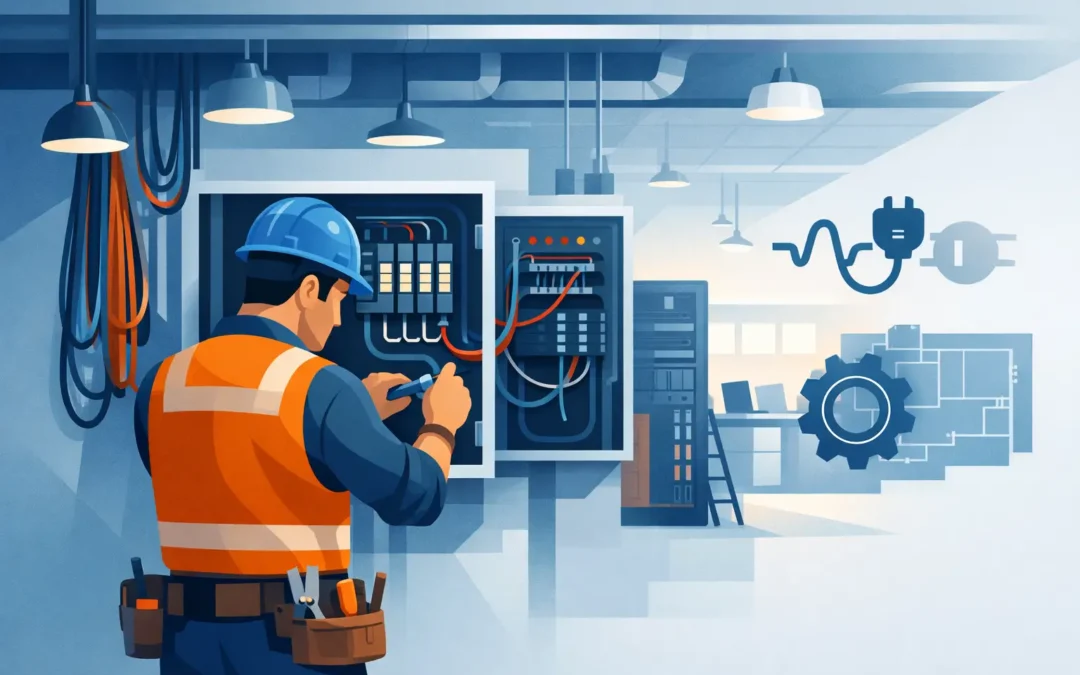
If you are planning a tenant fit-out, opening a retail space, or managing an office building, one of the first practical questions is what is commercial wiring and how is it different from the wiring in a house. The short answer is that commercial wiring is the electrical system designed for business properties, larger electrical loads, stricter code requirements, and equipment that needs to run safely and consistently every day.
That sounds simple enough, but the details matter. In a commercial setting, the wiring has to support lighting, outlets, HVAC systems, data equipment, emergency systems, and specialized machinery, often all at once. It also has to stand up to heavier use, future changes, and inspections that are less forgiving when safety or compliance is on the line.
What is commercial wiring?
Commercial wiring refers to the cables, conduits, panels, circuits, and related electrical components installed in buildings used for business or public operations. That includes offices, restaurants, warehouses, retail stores, schools, medical clinics, mixed-use properties, and industrial workspaces.
Unlike residential wiring, commercial systems are usually built to handle more power, more users, and more complicated layouts. A small office may need dedicated circuits for computers, copiers, and network gear. A restaurant may need heavy-duty power for kitchen equipment, refrigeration, lighting, and ventilation. A warehouse may require high-bay lighting, motor controls, and distribution equipment that can support changing operational needs.
In other words, commercial wiring is not just more wiring. It is a more demanding system that has to be designed around safety, reliability, code compliance, and the way the business actually uses the space.
How commercial wiring differs from residential wiring
The biggest difference is load demand. A home electrical system is built around everyday household use such as lighting, kitchen appliances, laundry equipment, and heating or cooling. A commercial property often has longer operating hours, more occupants, and equipment that draws power continuously or in bursts throughout the day.
The installation methods are different too. In many commercial buildings, wiring is run through conduit for protection and access. That makes repairs, upgrades, and changes easier down the line, which matters in spaces where layouts and equipment can change. Residential work often relies more heavily on cable concealed inside finished walls.
There is also the issue of voltage and service size. Commercial buildings may use larger panels, three-phase power, dedicated circuits, and more complex distribution systems. That does not mean every commercial space is massive or industrial. A small storefront can still have a relatively modest setup. But even modest commercial jobs typically require more planning than a standard home installation.
Then there is compliance. Commercial work usually involves stricter inspection requirements, emergency lighting considerations, fire alarm coordination, occupancy-related rules, and equipment-specific standards. If the wiring is not done properly, the result is not just inconvenience. It can delay occupancy, create safety risks, and lead to expensive corrections.
What is included in a commercial wiring system?
A commercial wiring system usually starts at the service entrance and extends through every area where power or control is needed. That can include main panels, subpanels, branch circuits, receptacles, interior and exterior lighting, switchgear, disconnects, conduit, cable trays, dedicated equipment feeds, grounding, surge protection, and backup power connections.
Many commercial jobs also include low-voltage coordination for communication systems, security devices, access control, and data infrastructure. While those systems are not always installed by the same trade, their placement often needs to be planned alongside the electrical work so the building functions properly.
For businesses, lighting is often a bigger piece of the system than people expect. Office lighting, showroom lighting, exterior security lights, parking lot fixtures, emergency exit signs, and motion-controlled fixtures all affect both safety and operating cost. A wiring plan that looks fine on paper can still be inefficient if it does not reflect how staff and customers actually use the space.
Why proper design matters in commercial spaces
Commercial wiring is not a place for guesswork. A system has to be designed around the building load, the use of the space, and realistic future needs. If circuits are undersized, overloaded, or poorly distributed, you may end up with nuisance tripping, equipment problems, or expansion limits much sooner than expected.
A common issue in fit-outs is treating electrical work like a finishing step instead of a core part of the build. By the time walls are framed and fixtures are selected, there may already be constraints on where panels, dedicated circuits, and equipment feeds can go. That often leads to change orders, delays, or compromises that could have been avoided with early planning.
Good commercial wiring design also protects business continuity. If one panel issue takes out critical equipment, point-of-sale systems, or lighting in an occupied area, the cost is not just electrical repair. It can mean lost sales, interrupted operations, and frustrated tenants or staff.
Common types of commercial wiring jobs
Some commercial projects involve new installations from the ground up. Others are upgrades, repairs, or reconfigurations in an occupied building. Both require a careful approach, but the challenges are different.
In a new build or tenant fit-out, the work may include full rough-in and finish, service installation, lighting layout, panel setup, dedicated equipment circuits, and final testing. In an existing property, the job might involve adding circuits, replacing outdated panels, upgrading lighting to LED, correcting code issues, or troubleshooting faults that are affecting daily operations.
Service upgrades are especially common in older buildings. A business may add new equipment, renovate the space, or take over a unit that was wired for a completely different use. A retail unit becoming a salon, a bakery, or a medical office can create a major shift in electrical demand. The old setup may technically still function, but that does not mean it is suitable or safe for the new use.
Safety and code compliance are not optional
In commercial properties, electrical safety is tied directly to liability, insurance, inspections, and day-to-day operations. Faulty wiring can cause overheating, shock hazards, equipment failure, and fire risk. It can also create problems that are harder to spot, such as voltage drop, poor grounding, or overloaded circuits that only show up when the business is at full use.
Code compliance is part of that picture, but it is not just about passing an inspection. A code-compliant installation is meant to protect occupants, support safe maintenance, and reduce the chance of failures under normal use. That matters whether you run a small office or manage a larger facility.
This is where hiring a licensed electrical contractor matters. Commercial systems need to be installed and tested by professionals who understand load calculations, panel capacity, equipment requirements, and the practical realities of working in active business environments. Speed matters, but not at the expense of workmanship.
When to call for commercial wiring work
If you are renovating a business space, adding equipment, dealing with repeated breaker trips, noticing flickering lights, or preparing for a new tenant use, it is time to have the wiring assessed. The same goes for buildings with aging electrical infrastructure, especially if there is no clear record of previous upgrades.
Even if the issue seems minor, small symptoms can point to larger capacity or safety problems. A single dead outlet may be a simple repair. Or it may be a sign that a circuit is poorly configured, overloaded, or affected by a hidden fault. In commercial spaces, the only responsible way to know is proper inspection and testing.
For property managers and business owners, the best electrical work is often the work that prevents disruption before it starts. That means looking at the system before a lease turnover, before a major equipment purchase, or before cosmetic renovations cover up underlying electrical limitations.
What is commercial wiring really about?
At its core, commercial wiring is about building an electrical system that fits the way a business operates. Not just today, but under real use, during busy hours, and as the space changes over time. That is why the right installation is never only about putting wires in walls. It is about capacity, safety, access, compliance, and keeping the property functional without wasting time or money on preventable problems.
For business owners and property managers, a good commercial wiring job should feel straightforward. The system should support the space, pass inspection, and work the way it is supposed to. If you are asking the right questions early, you are already in a better position than the people who wait until the lights start flickering or the breakers start tripping.